About Palazzo Grimani
Palazzo Grimani: a Roman-inspired palace in Renaissance Venice
Palazzo Grimani at Santa Maria Formosa differs sharply from the Gothic palaces lining the Grand Canal. The Grimani family transformed an older house during the sixteenth century into a residence inspired by Roman architecture, with a monumental courtyard, classical proportions, stucco and fresco. Vettore and Giovanni Grimani drove the decoration from the 1530s.
Giovanni, Patriarch of Aquileia, assembled an important collection of Greek and Roman sculpture. In 1587 he donated much of it to the Venetian Republic, where it became foundational to the public Statuario della Repubblica and the later National Archaeological Museum. The palace’s Tribuna was designed as an architectural setting for antiquities rather than a neutral gallery.
The Tribuna and restored collection
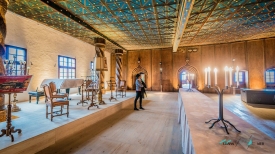
Today ancient sculptures are again displayed through the Tribuna and principal rooms, restoring a relationship between collection and architecture that had been broken by dispersal. The soaring Tribuna, with its niches and overhead Ganymede, stages sculpture through controlled sight lines. Nearby rooms contain mannerist decoration by artists including Giovanni da Udine, Francesco Salviati and Federico Zuccari.
The collection is not identical to Giovanni Grimani’s sixteenth-century arrangement, and temporary exhibitions alter individual rooms. Visitors should read labels distinguishing original fabric, returned loans and contemporary interventions. The palace itself is the primary object.
- Look upward in the Tribuna and decorated stairways.
- Follow photography restrictions around loans and temporary exhibitions.
- Allow 60–90 minutes despite the museum’s compact footprint.
- Do not confuse Palazzo Grimani with Palazzo Grimani di San Luca.
Verified 2026 hours and arrival
The official museum lists opening Tuesday through Sunday from 10:00 a.m. to 7:00 p.m., with last admission at 6:00. Monday is closed. Tickets can be purchased at the museum, through the Musei Italiani app or the official portal; prices and combined offers should be checked at purchase because temporary exhibitions may affect them.
The address is Castello 4858, in Ramo Grimani near Campo Santa Maria Formosa. It is easily reached on foot from Piazza San Marco; Rialto and San Zaccaria are the useful vaporetto areas. Venice has many similarly named palaces, so navigate to the museum’s Castello address.
Accessibility and museum etiquette
Historic thresholds and stairs make advance accessibility planning advisable, though staff can identify the current assisted route. Large luggage is inappropriate and cloakroom capacity can be limited. Special evening openings operate only on announced dates.
Palazzo Grimani reveals how collecting shaped architecture and public culture in Venice. Ancient sculpture served Renaissance scholarship and family status, then entered civic collections, and now partially returns to its designed setting. That circulation—not simply a room of beautiful statues—is the palace’s most compelling story.