Mackenzie Castle in Genoa: Coppedè’s imagined medieval world
A castle imagined for a modern city
On the hillside of Genoa’s Castelletto district, Mackenzie Castle rises above a city better known for its port, narrow lanes and Renaissance palaces. Its crenellated towers and stonework suggest a medieval fortress, but the building belongs to the turn of the twentieth century. The Genoa municipality describes it as an early work by architect Gino Coppedè, created for Evan Mackenzie, an insurance magnate who wanted a conspicuous home.
The project dates and opening date are not always given the same way. A municipal account identifies Coppedè’s work as 1897–1902, while a University of Genoa record says the building was inaugurated in 1912; other local documentation places the wider construction period from 1893 to 1905. These dates likely describe different stages, but the public sources do not reconcile them fully. The safest summary is that design and construction unfolded across the late nineteenth and early twentieth centuries.
Mackenzie was not commissioning a faithful reconstruction of a documented medieval castle. Coppedè assembled towers, battlements, arches and decorative references into an imaginative historicist composition. The city’s own cultural writing calls it a “dreamed Middle Ages.” That phrase captures the building’s appeal: it borrows from the past without pretending to be a single-period fortress. Its setting above the city gives the silhouette the theatrical presence of a landmark.
Inside the architecture
The Regional Secretariat of the Ministry of Culture describes a complex arranged over several levels, with approximately fifty rooms, staircases, halls and service spaces. The castle includes an internal chapel and artificial underground caves connected to its lower levels. These elements create an interior that is less like a single grand room and more like a sequence of changing spaces. Access to all of them, however, is not part of an ordinary walk-in visit.
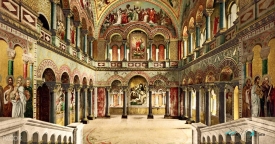
Public descriptions emphasize the entrance hall and monumental staircase, painted decoration, carved details and historic furnishings. The building’s theatrical quality continues indoors: movement through the rooms reveals shifting views, changes in level and decorative surprises. Coppedè’s design makes the visitor feel as if the castle is being discovered in stages. That experience is part of its architectural meaning, not simply a backdrop for photographs.
Some of the construction also reused or incorporated earlier structures and the area’s historic defensive fabric. This layering helps explain why the castle can feel older than it is. Yet its look should be understood as an early twentieth-century interpretation of medieval forms, not evidence that the entire complex dates from the Middle Ages. Separating architectural invention from genuine earlier fabric makes a visit more rewarding and avoids turning style into false history.
The castle’s surroundings matter as well. It occupies an elevated residential part of Genoa, and its towers form a distinctive point in the city’s uphill landscape. Visitors can place it within the wider story of Genoa’s hillside villas and changing urban quarters, but should remember that the interiors are not continuously open to independent sightseeing. The exterior and the interior have different access rules, and the castle’s working use shapes what can be seen.
From residence to auction-house venue
After the Mackenzie family period, the building passed through several uses and owners. The University of Genoa’s record notes service as a Carabinieri command, a military command, a gymnasium and later the residence of collector Mitchell Wolfson Jr. The auction house Cambi acquired and restored the castle in the early 2000s, and today uses it as its Genoa headquarters and a venue for auctions and exhibitions.
That current role keeps the castle active, but it also means visitors should not expect a conventional museum with daily public hours. Cambi’s sales and exhibition programme changes over time. Some events welcome visitors or collectors, while other rooms may be closed or reserved for business. The auction-house website is the best source for a specific exhibition, viewing period or event; confirm whether registration is required before travelling.
The Ministry of Culture’s regional office lists an occasional opening of the artificial underground caves on the second Saturday of each month, generally from 9 a.m. to 1 p.m., subject to the current notice. This is not a promise that the full castle is open on that day. The notice concerns particular spaces and may be updated; check the regional Culture Ministry page close to your visit and follow the stated entrance and booking requirements.
Genoa’s cultural calendar has also included guided visits and special events inside Mackenzie Castle. Those programmes are episodic, not a permanent visitor service. An event listing from a previous year should not be treated as current admission information. If the castle is closed to the public on your dates, the city’s architecture and heritage resources can still provide context, while the surrounding district offers a sense of the hillside setting.
Planning a responsible visit
The address listed in heritage records is Mura di San Bartolomeo, in Genoa’s Castelletto area. The slope and stairs are part of the setting, so allow time for a walk uphill and check transport options if mobility is a concern. Since the site operates as an auction venue, verify the exact entrance and event arrangements in advance. Do not arrive assuming that a map listing or exterior view grants access to the interior.
For an exhibition or auction preview, review Cambi’s event page for the dates, opening window and any registration instructions. For the occasional cave opening, use the current regional ministry notice rather than relying on an old travel article. Ask whether photography is allowed and which parts are accessible. Historic buildings contain uneven floors, stairs and areas used for business; follow staff directions and respect barriers even when a room is visible.
Architecture-minded visitors can look for how Coppedè combines a castle vocabulary with a deliberately eclectic composition. Notice the towers and battlements from outside, then compare that imagined medieval image with the building’s early twentieth-century date. If a guide or event interpreter is available, ask which elements belong to the original project, which spaces were altered for later uses, and what restoration work changed. Those questions make the visit more grounded than simply calling the building “medieval.”
Mackenzie Castle rewards curiosity precisely because it resists easy labels. It is a private residence turned cultural and commercial venue, an architectural fantasy built in a modern city, and a landmark whose public access is limited and occasional. Check the current programme, plan around confirmed opening arrangements and let the building’s layered use shape expectations. A verified, modest visit is better than travelling on the assumption that every historic façade is an open museum.