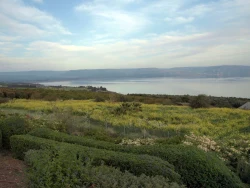
Laacher See: a volcanic lake beside Maria Laach Abbey
A lake in the volcanic Eifel
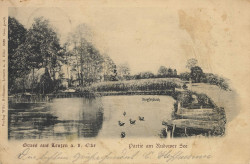
Laacher See, often called Lake Laach in English, lies in the eastern Eifel of Rhineland-Palatinate, close to the Benedictine Abbey of Maria Laach. At about 3.3 square kilometres, it is the largest lake in the state, set within a wider landscape of woodland, volcanic landforms and small communities. The name can suggest a simple lakeside outing, but the place rewards a broader look: the water, the abbey and the surrounding protected land belong to one closely connected cultural and natural setting.
Published figures for the lake’s maximum depth differ slightly. The regional tourism authority gives 53 metres, while the Rhineland-Palatinate bathing-water database lists 51 metres. Both describe a lake of around 3.3 square kilometres. Rather than imply a precision the sources do not share, it is better to use the consistent area and note that official pages give a depth in the low-fifties of metres. The lake and surrounding properties are owned by Maria Laach Abbey, and the wider protected area is the largest nature reserve in Rhineland-Palatinate.
How an eruption made the basin
The present lake occupies a water-filled caldera, not a typical maar or a crater left intact after an eruption. Around 13,000 years ago, a major explosive eruption emptied part of the magma system beneath the volcanic cone; the roof then collapsed, leaving a broad basin that gradually filled with groundwater and precipitation. Volcanic ash and pumice from the event spread across Central Europe and provide geologists with a distinctive layer for comparing and dating deposits in different landscapes.
The eruption’s exact age has been refined as researchers compare independent records. A recent study matched a volcanic sulfur signal in a German cave formation with Greenland ice-core chronology and estimated an age of 13,008 ± 8 years before 1950. Other records have produced different estimates, so the useful travel-level description remains “about 13,000 years ago.” That precision matters to climate and geological research; for a visitor, it explains why the lake is both a beautiful destination and a key marker in the natural history of the Eifel.
Gas seeps, science and measured context
Small bubbles known as mofettes rise through the water near parts of the shore, especially on the eastern side. They are evidence of carbon-dioxide emissions associated with the volcanic system, not a spectacle staged for visitors. Their presence has made Laacher See a place of scientific interest as well as recreation. Researchers have also reported deep, low-frequency earthquakes beneath the region that can indicate movement of magmatic fluids far below the surface.
That science should be described without sensational claims. In a 2019 report, the German Research Centre for Geosciences and partner agencies said the recorded earthquakes were not interpreted as an immediate warning of an eruption at that time, while calling for further gas and ground-deformation monitoring. A 2026 scientific-drilling paper describes Laacher See as a dormant system that is still degassing and discusses ways to study it. This is continuing research, not a forecast. A bubbling mofette is interesting geology, but by itself it does not predict an imminent event.
Maria Laach Abbey: a second reason to stop
The abbey gives the lakeside visit a human history that reaches back far beyond modern tourism. Its own chronology says that Count Palatine Henry II founded the Benedictine monastery in 1093. The six-towered Romanesque abbey church remains the visual centre of the complex and is an active religious building, not merely a museum interior. Visitors arrive for architecture, worship and the atmosphere of a working monastery as well as for the water and volcanic landscape nearby.
The abbey’s history includes interruption and renewal. It was dissolved in 1802 during secularisation; in 1820 the monastery, lake and estate were acquired together as agricultural property. A fire heavily damaged monastic buildings in 1855. Benedictine monks from Beuron resettled the abbey in 1892, and Pope Pius XI granted the church the title of minor basilica in 1926. The centenary of that title falls in 2026. These changes help explain why the present site combines a medieval foundation, later rebuilding and a living monastic community.
Walking routes, swimming and seasonal boating
Walking is the most dependable way to experience the landscape. The regional tourism authority describes the Laacher Rundweg, a circular hiking route of 15.4 kilometres, as an easy walk taking about three hours and 38 minutes, with roughly 249 metres of ascent. A shorter, separate 2.1-kilometre section runs between the Maria Laach visitor car park and the campsite; it is not a loop and is described as partially accessible. Check current trail notices after heavy rain or maintenance, and choose a route that matches your mobility and footwear.
Swimming is not permitted freely around the whole shoreline. The abbey says bathing is allowed only through the campsite on the lake’s north side; the state bathing-water database lists the bathing facility and campsite season as April through September. Boat hire is seasonal too. On 5 October 2026, the abbey’s own schedule listed its 2026 rental period as ending on 3 October, while the regional tourism portal displayed a longer season through 31 October with different daily hours. Because these official pages conflict, contact the boat operator before travelling specifically to rent a boat; do not assume it is operating.
Getting there and planning a considerate visit
The regional authority lists the stop “Maria Laach Parkplatz” beside the abbey church, making a bus journey possible; check current connections through the regional transport service before setting out. Drivers can reach the area from the A61 motorway, but should use designated parking rather than roadside verges. The tourist information office is by the large monastery car park. Abbey grounds, church access, shops, food services and guided visits have their own schedules, so confirm those details directly if they are central to your plans.
Laacher See works best as an unhurried visit: combine the abbey with a section of lakeside walking, or set aside most of a day for a longer route. Keep to marked paths and follow nature-reserve guidance, since recreation can disturb wildlife and sensitive shore habitats. For current water quality, bathing access, trail closures and seasonal services, consult the relevant official page rather than an old travel listing. The appeal here is the meeting of deep geological time and a living religious landscape; a thoughtful visit makes room for both.