Falaknuma Palace, Hyderabad: a hilltop home of the Nizams
A palace above Hyderabad
From a hill south of Hyderabad’s old city, Falaknuma Palace looks back toward a metropolis shaped by the Deccan sultanates and the Nizams. Its name comes from Urdu and is commonly rendered as “mirror of the sky” or “like the sky.” Telangana Tourism places it about five kilometres from Charminar. That distance is short on a map, but the palace’s setting feels removed from the crowded streets below.
The palace began as the residence of Nawab Vikar-ul-Umra, a prominent member of the Paigah nobility and a senior figure in Hyderabad’s court. Telangana Tourism credits English architect William Ward Marret with its design and describes a blend of Italian and Tudor influences. Construction is generally dated to 1884–1893. Rather than a public monument built for crowds, it was a private home whose scale and decoration expressed the standing of its owner.
Falaknuma later passed to the sixth Nizam, Mahbub Ali Khan, and became associated with royal hospitality. The Paigahs were an influential noble family whose members held important positions under the Nizams. The palace therefore links two strands of Hyderabad’s history: the courtly world of the Asaf Jahi rulers and the political and social influence of families who served that dynasty. Its identity is not simply “European architecture in India,” but a local court’s selective use of global styles.
Interiors made for ceremony
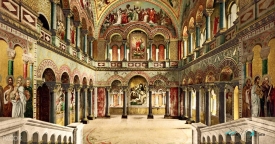
Visitors who enter through an authorized hotel experience encounter a sequence of formal spaces rather than a single gallery. The State Reception Room, with painted and gilded decoration, is among the interiors highlighted by the state tourism profile. Marble stairs, chandeliers, carved surfaces and historic furnishings create a strong impression, but the rooms also record how Hyderabad’s ruling elite adapted European forms to its own protocols of hospitality and display.
The palace library is another celebrated feature. Telangana Tourism describes a collection containing books in English, Urdu and Persian, a reminder that the court operated across languages and intellectual traditions. The hotel’s current materials also present archival images and memorabilia as part of the palace story. Such objects help move a visit beyond visual splendour: they connect rooms to the people, reading practices and administrative culture that once gave them meaning.
From private residence to working hotel
For decades Falaknuma remained a private palace and was not a conventional walk-in attraction. Telangana Tourism says a luxury hotel group undertook its revival in 2000, while Taj’s hotel materials identify the property today as Taj Falaknuma Palace. The hotel reopened in 2010 after extensive restoration. These dates describe different stages—decision and restoration effort, then reopening—rather than a contradiction about a single opening day.
Its present role is therefore both preservation and hospitality. The hotel operates guest rooms, dining venues and event spaces within a protected historic setting. The official dining page lists restaurants including Adaa, focused on Hyderabadi cuisine, and Celeste, with Italian and international offerings; opening times and service can vary. The hotel’s factsheet describes food as an interpretation of Nizami feasts, not an unchanged palace kitchen serving the original court.
This distinction matters to trip planning. A hotel guest can access the property as part of a stay, but the palace is not an unrestricted public museum with guaranteed entry at any hour. Non-resident access may be possible through a reservation for dining, a special experience or a state tourism package, subject to availability and the hotel’s rules. Confirm the exact arrangement directly before travelling; a restaurant booking should not be assumed to include every room, garden or guided visit.
Telangana Tourism advertises a Hyderabad palace tour that includes Falaknuma, but package details, departure times and prices can change. The hotel’s own contact details and reservation channels are the safest starting point for current access. Ask what is included, where to report, whether transport is provided and what areas are open. This practical check prevents disappointment and respects the fact that the building remains an operating hotel as well as a heritage site.
Planning a visit with realistic expectations
Falaknuma is in Hyderabad’s Falaknuma area, roughly five kilometres from Charminar according to the state tourism profile. Road time will depend on traffic, so allow more than the map distance suggests. If visiting through a hotel experience, confirm the address, arrival instructions, dress expectations and photography rules in advance. For a stay, use the hotel’s official booking channel and check its current policies rather than relying on old listings or third-party summaries.
Visitors interested in architecture can look for the contrast between the palace’s elevated, European-influenced composition and details rooted in Hyderabad’s courtly culture. Notice how the reception halls, library, dining spaces and gardens each frame a different kind of encounter. A knowledgeable guide or hotel representative can explain which furnishings are original, restored or introduced later. That distinction is important in a restored palace: careful interpretation is more informative than assuming every object has remained untouched since the nineteenth century.
For travellers who cannot arrange entry, the palace still has a place in a wider Hyderabad itinerary. Charminar, the old city and other historic sites offer context for the court that shaped the region, while the hilltop outline of Falaknuma helps explain how the city’s landmarks relate to one another. Respect private grounds and do not attempt to enter without permission. A view from a lawful public vantage point is preferable to treating a hotel’s perimeter as an open attraction.
Falaknuma’s appeal lies in the way a residence makes power visible: in its position above the city, its formal rooms and its blend of local and international references. The modern hotel gives some visitors a route inside, but it does not erase the palace’s private origins or guarantee unrestricted access. Plan through current official channels, ask what the reservation includes, and let the building’s layered story—not an assumption of open admission—shape the visit.