Diamantina, Brazil: diamond history, hillside streets and visitor guide
A colonial town shaped by a steep valley
Diamantina stands in the rocky highlands of northeastern Minas Gerais, where its historic streets climb and descend along a steep valley rather than following a level grid. UNESCO describes the centre as rising about 150 metres up the slope, with winding, uneven routes that reflect the terrain. That relationship between town and landscape is central to the visit: the view changes as streets bend, and houses, churches and public spaces appear in layers against the surrounding mountains. The result is not a stage set of isolated monuments but an urban fabric shaped by adaptation to a demanding environment.
The settlement was first known as Arraial do Tijuco and grew during the colonial period as diamonds were found and mined in the region. Its name, Diamantina, preserves that association with precious stones. The historic centre entered UNESCO’s World Heritage List in 1999. The recognition is not based only on the town’s mining past: UNESCO emphasizes how Portuguese architectural models were adapted to an American setting and how the built environment was integrated into the rocky hills. A visit becomes more rewarding when the street plan is read alongside the history of prospectors, colonial administration and local cultural life.
Architecture that follows the land
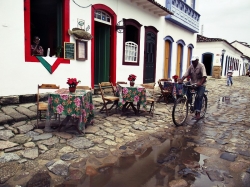
Diamantina’s houses and religious buildings differ in detail from the better-known Baroque centres elsewhere in Minas Gerais. UNESCO points to the use of wood and to geometric details that reflect Portuguese influences on a more modest scale. Many churches share colours and textures with nearby civic buildings, and most have a single tower. Eighteenth- and nineteenth-century houses stand in aligned rows, often one or two storeys high, painted in bright colours against white backgrounds. Grey stone paving and the steep slope complete a streetscape in which architecture and terrain are inseparable.
Rather than expecting one monumental axis or a single grand square to explain the town, notice how each block adjusts to the gradient. Streets bend, steps and slopes change pace, and façades form a continuous edge that follows the hillside. UNESCO says the historic centre preserves an urban fabric documented since its formation in the eighteenth century. The setting also makes practical planning important: comfortable shoes, time for uphill sections and pauses at viewpoints can transform what might otherwise feel like a difficult climb into a closer encounter with the place.
From diamond prospecting to a living heritage centre
The history of Diamantina is tied to the expansion of Portuguese colonial power into Brazil’s interior. Explorers, diamond prospectors and representatives of the Crown shaped a settlement that adapted European forms to local conditions. UNESCO’s account describes this process as the creation of an original culture, not a simple copy of a Portuguese town. The historic centre’s inscription rests on both this cultural adaptation and the way the architectural ensemble is integrated into a rugged landscape. It is a reminder that the built heritage reflects economic ambition as well as artistic skill.
Diamantina remains a lived-in city rather than an open-air museum. The historic area is predominantly residential, and religious festivals and public traditions continue to use its streets. UNESCO identifies this continuity of use as part of the place’s character. For visitors, that means a walk may share space with daily errands, local celebrations or university life. Respect residents’ privacy, keep routes open, and remember that preservation is not simply about façades: it depends on the continued relationship between buildings, public roads and the people who use them.
Casa da Glória and the famous passadiço
One of Diamantina’s best-known landmarks is Casa da Glória, a complex of two buildings from the eighteenth and nineteenth centuries joined by an elevated covered passageway, the passadiço. The municipal tourism portal says the buildings once housed a school run by the Vincentian sisters and now serve as the seat of the Instituto Casa da Glória of the Federal University of the Jequitinhonha and Mucuri Valleys. The unusual link between the buildings has become one of the town’s most recognizable views, but the site also has an institutional and educational life beyond its appearance in photographs.
The municipality lists Casa da Glória at Rua da Glória, 297/298, and publishes weekday hours of 8 a.m. to 6 p.m., with a telephone contact for tourism questions. Because the municipal page does not spell out every access condition, confirm whether interior areas are open to general visitors before making a special trip. Even when viewed from the street, the passadiço rewards attention to how historic buildings were adapted to the slope and to changing uses over time. Ask locally about any temporary restrictions, academic activities or conservation work that may affect access.
Vesperata: music among the old façades
Diamantina’s Vesperata turns Rua da Quitanda into an open-air performance setting. In the municipal description, musicians play from the balconies of historic houses, making the street itself part of the sound and spectacle. The event is presented as a distinctive local tradition and is scheduled seasonally rather than held every night. It can add a memorable evening to a heritage visit, but it also requires advance planning because seating, dates and ticket arrangements are managed separately from ordinary access to the historic centre.
The city’s 2026 calendar lists performances from April through October, with the final published dates on 10 and 17 October 2026. Its notice said table sales and reservations were still being finalized, so do not rely on an old event listing or buy from street resellers. The municipal Vesperata page and FAQ direct enquiries about dates, tables and prices to the authorized organizer and warn visitors to use official channels. Check those pages before travel for current availability, payment conditions and any changes; the atmosphere may be public, but reserved seating and event services have their own terms.
Planning a thoughtful visit
Diamantina is best explored on foot in sections. Start with the central streets and architecture, then choose a museum, church or cultural institution whose current visitor information you have confirmed. The Casa da Glória listing gives a useful weekday reference, while the Vesperata is an event-specific experience that should be planned around the official calendar. Opening arrangements for religious buildings and collections may differ, and heritage sites can adjust access for maintenance or ceremonies. Check current notices instead of treating a general town itinerary as a guarantee that every interior will be open.
Allow more time than a map might suggest: steep gradients slow the route, while the changing views invite pauses. The town’s UNESCO value is not limited to famous buildings; it also lies in the sequence of façades, stone paving, narrow roads and mountain edges. Take care on uneven surfaces, especially after rain, and avoid blocking doorways or photographing residents without permission. Local tourism staff can help with current cultural programming and logistics. A rewarding visit balances the diamond-era story with the present-day city that continues to inhabit and care for its historic setting.