Argos, Greece: ancient theatre, reopened museum and a city guide
Argos rewards visitors who look beyond the headline ruins. In this Peloponnese city, an ancient theatre rises beside Larissa Hill, the remains of the public agora lie within the modern urban fabric, and a newly reopened archaeological museum brings finds from the surrounding region together. These are not one enclosed attraction: they are separate places with different access arrangements, set among the streets of a living town. A well-planned visit can connect them in a day, while a broader archaeological circuit through Argolis needs longer and advance checks of each site’s hours.
A theatre built for a city and its festivals
The Ancient Theatre of Argos is one of the city’s most striking landmarks. The Ephorate of Antiquities of Argolida dates the present theatre to the early third century BC, during the Hellenistic period, and estimates that it could hold about 20,000 spectators. It was built on the southeastern side of Larissa Hill, in visual and functional relation to the agora. The authority says it replaced an earlier theatre about 100 metres to the south, built in the fifth century BC.
The site was more than a venue for plays. The Ephorate says the Hellenistic theatre was probably constructed for musical and dramatic contests connected with the Panhellenic Nemean Games; its account also records that the games later moved from the sanctuary at Nemea to Argos, alongside the Heraian competitions. A documented contest in 205 BC featured singers and guitar players. In the second century BC, the theatre also hosted political assemblies of the Achaian League. This mixture of performance, civic life and festival helps explain why the structure was integrated with the public centre rather than placed apart from it.
Much of the seating bowl and orchestra was cut into bedrock. The Ephorate describes 83 rows in the central section and an underground passage connecting the orchestra with backstage areas. During Roman rule, especially in the second century AD under Hadrian, the theatre was remodelled for new festivals and spectacles. Its orchestra and stage changed over time; a water feature for aquatic performances was added in the fourth century. The monument was abandoned by the late fourth century and conserved in work completed in 2004.
Agora, hilltop fortifications and layered history
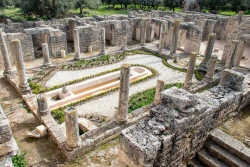
East of Larissa Hill, the Roman Agora occupied a level area that the Ephorate identifies as the centre of public life in Argos. The second-century traveller Pausanias described monuments and public buildings there. Excavations by the French School at Athens, in collaboration with Greek archaeological authorities, have continued since 1952. The official account says the agora’s development began in the sixth century BC, reached its completed form by the end of the fourth century BC, and lost its public character toward the end of the fourth century AD, as houses and workshops gradually replaced monumental buildings.
Above the city, Larissa Castle adds a different chapter. The Argolida Ephorate says traces of Mycenaean fortifications from the thirteenth century BC survive in the citadel, while much of the visible arrangement took shape in medieval times. Fortifications on the hill were repeatedly changed as rulers and military technology shifted. The record traces control through Byzantine, Frankish, Venetian and Ottoman periods and describes further strengthening when firearms altered defensive design. The site’s history continued into the Greek Revolution of 1821; the hill functioned as a fortified observation post and a final line of defence for the city.
At Argos, ancient civic space, Roman reuse and later defensive architecture overlap geographically but remain distinct archaeological sites. The local antiquities authority recommends a larger route linking the city museum, theatre, Roman Agora, Aspida Hill and Larissa Castle, with other monuments elsewhere in the municipality. It estimates two days for the full itinerary, depending on site hours.
A museum newly open to visitors
The most important practical change for travellers is the Archaeological Museum of Argos, which reopened to the public in June 2026 after extensive building work and a new display. The Greek Ministry of Culture says the museum occupies a complex that includes the historic residence of General Dimitrios Kallergis, built in 1830, and a later wing. Its new permanent exhibition is arranged in nine thematic sections and follows the history and culture of Argos through objects ranging from the Neolithic sixth millennium BC to late antiquity in the sixth century AD.
As of the museum page’s update on 1 October 2026, the published hours are 8:30 a.m.–3:30 p.m. in both seasonal schedules, with Tuesday listed as the weekly closing day. The ticket is €10 in the summer season, 1 April–31 October, and €5 in winter, 1 November–31 March. Last admission is 20 minutes before closing. The Ministry notes that hours may change, and that museums close on certain public and religious holidays; it advises visitors to call ahead for confirmation. Because the reopening is recent, use the Ministry’s current listing rather than older pages that still describe the museum as closed.
The museum also offers multimedia and educational programmes and lists a ramp, lift and accessible toilet among its facilities. It is at 2 Vasilissis Olgas Street; the published telephone number is +30 27510 68819. It can be a useful first stop before visitors continue to the theatre or agora. Check the official record before departure if accessibility arrangements or a holiday schedule matter to your visit.
Planning a rewarding visit to Argos
Argos is best approached as a set of connected but separate visits. Start at the Archaeological Museum when it is open, then make time for the theatre and the remains of the agora; add Larissa Castle if the day, weather and access conditions allow. The sites are not all described on one ticket or under one opening schedule. The theatre page currently lists a standard ticket of €10 and a reduced ticket of €5, with additional eligibility rules for free or reduced admission. It does not provide a dependable daily timetable in the record reviewed here, so confirm opening hours and ticket conditions with the Ephorate or official ticket service before setting out.
Allow time to move between the archaeological areas and the modern town rather than expecting a single fenced complex. The theatre’s place beside the hill, the agora’s position east of it and the museum’s address within Argos tell a story about how the ancient city related to its civic centre and surrounding landscape. For a longer stay, the Ephorate’s two-day itinerary adds sites across the municipality and Argolis, but each organised archaeological site may have its own admission window. Do not assume that an outdoor monument, a museum and a castle share the same hours or entry rules.
Argos stands out because the visitor can read several periods without reducing the city to a myth or a single ruin. The theatre links performance and political assembly; the agora recalls public life and excavation still in progress; Larissa preserves successive layers of defence; and the reopened museum gives the finds a contemporary setting. Check current schedules, plan around the museum’s Tuesday closure, and leave room for the streets between sites. That approach turns Argos from a brief stop on the way to better-known Peloponnese destinations into a destination with its own archaeological and urban story.