Bornem Castle: Flemish history beside the Old Scheldt
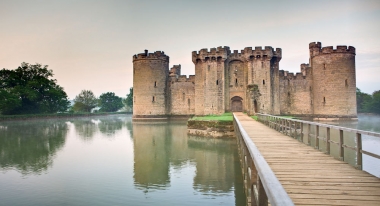
At Bornem Castle, water changes the way the building is seen. The towers and pale façades stand beside the Old Scheldt, their outlines reflected in a river landscape that has been shaped by centuries of human decisions. The romantic silhouette suggests a medieval fortress, yet much of the castle visible today belongs to a later rebuilding. Its interest lies in that mixture: an ancient lordship, a historic waterway and a family residence remade for the nineteenth century.
This is the Castle of Bornem associated with the Marnix de Sainte-Aldegonde family, not the nearby d’Ursel Castle at Hingene. A guided visit opens a window onto furnished rooms, collections and the changing uses of the estate. Outside, the Old Scheldt offers a quieter way to understand why this place mattered long before visitors came to admire its reflection.
A lordship on changing water
The estate’s historical account refers to an early motte-and-bailey castle and to the viscounts of Ghent, who held Bornem from the early eleventh century until 1250. Its earliest origins are not described with equal certainty: stories of a Roman watchtower are presented as stories, and are best approached as part of local tradition rather than an established architectural date.
In 1250 Margaret of Constantinople, Countess of Flanders, acquired the castle and lordship. In the following century Robert of Cassel held rights connected with the river. According to the estate, embankments and a lock linked the Old and New Scheldt as the waterways changed. The old channel remains central to the setting today, a visible reminder that a castle’s position could depend as much on controlling water as on controlling land.
Ownership passed through a succession of influential families. In 1586 Pedro Coloma, an officer in the Spanish army, bought the lordship after the fall of Antwerp and rebuilt a ruined castle. A seventeenth-century engraving recorded a different appearance from the one visitors see now. Bornem’s history is therefore not the history of a single unchanged building: it is a series of residences, damaged and remade as political fortunes shifted.
A nineteenth-century castle with older foundations
The estate passed to the Marnix family through inheritance in the eighteenth century. At the end of the nineteenth century Count Ferdinand Jozef commissioned a major transformation. Architect Hendrik Beyaert rebuilt the former fortified Renaissance castle; the estate explains that only sections of walls and the bases of towers remained from the earlier structure.
The result is a residence inspired by medieval forms, designed for a peaceful domestic setting. Looking across the water makes Beyaert’s composition especially clear: the castle appears closely tied to the reflective surface of the Old Scheldt. Its historic monument protection covers the castle and associated buildings, and the estate remains a lived-in family property.
That distinction is useful when visiting. The site has deep medieval roots, but it would be misleading to present every tower and façade as a medieval survival. Bornem invites the eye to enjoy its romantic appearance while the guided tour explains the succession of buildings behind it.
Rooms, books and a remarkable collection of prints
The castle’s rooms contain historic furniture, paintings, chandeliers and porcelain. The estate describes a dining room, salons, libraries and a lace room among the interiors. Their furnishings help explain how the building functioned as a residence, not just how it looked from the water.
One of the distinctive collections is devoted to engravings after designs by Pieter Bruegel the Elder. The estate describes it as an important private collection and has created an interpretive room to introduce the artist and his work. Another presentation concerns Philip of Marnix, a figure associated with the political and religious conflicts of the sixteenth-century Low Countries. As with any historic collection, what is accessible can vary with the tour or current arrangements.
The visitor programme also includes a carriage museum and an experience center. Together, these add context to the interiors: how people travelled, managed an estate and told the story of the families connected with it. The setting rewards a slower visit than a photograph of the façade alone.
Planning a visit
Bornem Castle is at Kasteelstraat 35 in Bornem, Belgium. The estate’s current visitor page says that the castle and castle garden are accessible only with a guide. It recommends reserving and notes that individual visits have seasonal and school-holiday arrangements; group visits have their own conditions. Events can change the usual schedule.
For the guided visit combining the castle, carriage museum and experience center, the estate currently lists €16 for adults and €8 for ages 6–18, with younger children free. The visit is listed at approximately an hour and three quarters. Confirm dates, language, availability and the latest price on the official visitor page and use its reservation link before traveling; these arrangements may change.
Leave time to take in the Old Scheldt and the approaches to the estate. The water is not simply a picturesque foreground. It connects the site’s medieval lordship, the shaping of the river and Beyaert’s later architectural vision. Bornem is most engaging when those layers are allowed to remain visible together.