Bojnice Castle: Slovakia’s storybook fortress and hidden cave
A fortress above the spa town
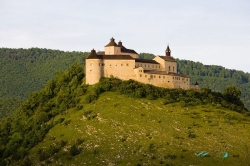
Bojnice Castle rises from a travertine mound in the centre of Bojnice, a small spa town near Prievidza in western Slovakia. Its steep rooflines, towers and pale walls look theatrical, but the place is more than a picturesque backdrop: it is a Slovak National Museum site with a long record of rebuilding and changing owners. The official museum calls it one of Slovakia’s oldest and most important monuments. Visitors can follow that history through furnished rooms, courtyards and a natural cave beneath the castle.
The first written reference dates to 1113, in a document associated with Zobor Abbey. The castle began as a wooden stronghold on an earlier fortified site; during the 13th century, the Poznań family rebuilt it in stone. Its position above the settlement was practical as well as imposing, giving the fort a commanding outlook over the surrounding landscape. The surviving complex should not be read as one untouched medieval design: each generation adapted the buildings to new military, residential and representational needs.
Ownership changed repeatedly in the late Middle Ages. The Hungarian magnate Matthew Csák held the castle until 1321, after which several noble families controlled it. In 1489, King Matthias Corvinus granted the estate to his son János Corvinus; after the king’s death, the Zápoľský family took possession. Ferdinand I later granted Bojnice to Alexej Thurzó in 1527. The Thurzós reshaped the Gothic fortress into a more comfortable Renaissance residence, with buildings arranged around an inner courtyard.
From aristocratic residence to romantic landmark
After the Thurzó line ended, the castle returned to the Crown and later passed to the Pálffy family. Count János Ferenc Pálffy, its last aristocratic owner, acquired the estate in 1852 and commissioned the transformation that defines today’s silhouette. Work began in 1889 and continued until 1910, under architect Jozef Hubert, while Pálffy himself directed and shaped the project. The design drew on French Gothic castles of the Loire, the papal palace at Avignon, Tyrolean Gothic and Italian Renaissance architecture.
The result deliberately mixes references rather than reconstructing a single medieval moment. Towers, courtyards and decorated interiors turn a layered fortress into a romantic residence. Pálffy died in 1908 before the rebuilding was complete, and disputes over his estate followed. His art collections were auctioned in 1924–26 after an agreement between his heirs and the Czechoslovak state. In 1939, the Baťa company bought the castle and its grounds; after the war, the property passed to the state.
A museum was established at Bojnice in 1950 and is now part of the Slovak National Museum. That institutional role changes how to plan a visit: entry is by ticket and the main route is a museum tour, not unrestricted access to every room. The museum offers a castle-and-cave tour and a separate chambers tour, with the selected route affecting both duration and ticket price. Wedding events can temporarily remove the Golden Hall from the route, so check notices before travelling if a particular interior matters to you.
The castle’s natural travertine cave is one of its less expected features. The official museum describes a chamber about 22 metres across and six metres high, 26 metres below the level of the fourth courtyard. Water entering through a crater and fissures gradually dissolved and carried away travertine, leaving a circular space with natural formations and two pools. The cave was rediscovered in 1888 while workers cleaned and repaired the castle well, then opened to visitors in 1967.
Rooms, underground geology and the castle park
The cave is included on the castle-and-cave route, but its presence is also a reminder that the site’s appeal is not purely architectural. A walk from the courtyards down into the rock reveals how the geology beneath the residence shaped its water supply and hidden spaces. The museum says the underground pools may connect with other cavities in the travertine mound. That possibility is presented as a geological observation, not as a confirmed network that visitors can explore independently.
Outside the walls, the landscape park extends the visit beyond the interiors. The museum records gardeners at the castle from 1910 and describes a naturalistic park with noteworthy trees. A lime tree known as the King Matthias Lime is linked to a local legend that Matthew Csák planted it in 1301; the museum labels that account as a tale, not established documentation. The tree later suffered storm damage and was placed under nature protection in 1969.
Give yourself time to move between the castle, the park and the town rather than treating Bojnice as a quick photo stop. The museum’s official address is Zámok a okolie 1, 972 01 Bojnice. Prievidza is the nearby district town and transport hub; regular public transport connects it with Bojnice, while Prievidza has bus and rail links to other Slovak destinations. Check current connections and the museum’s route information before setting out, especially if travelling without a car.
Hours, tickets and a practical visit
Opening times change by season. On the museum calendar checked for this article, November through March is Wednesday to Sunday, 10 a.m.–3 p.m.; April is daily except Monday, 10 a.m.–4 p.m.; May is daily except Monday, 9 a.m.–5 p.m.; June through August is daily, 9 a.m.–5 p.m.; September is daily except Monday, 9 a.m.–5 p.m.; and October is daily except Monday, 10 a.m.–3 p.m. The ticket office pauses from noon to 12:30, although tours already underway may continue. Recheck the official timetable before travelling.
Tickets are sold online and at the castle; the museum says its ticket office accepts cash and cards. Prices depend on the selected tour and visitor category, and special events use their own rates. The currently published castle-and-cave ticket is listed separately from the chambers tour, so compare what each route includes rather than assuming one ticket covers every interior. Photography and filming are permitted within the ticket price, but flash is prohibited and visitors are asked to follow the museum regulations.
Bojnice rewards a visit that balances its theatrical exterior with the documented story inside: a wooden stronghold, a stone medieval castle, Renaissance and Baroque changes, Pálffy’s long neo-Gothic project, a museum and a cave shaped by water. Build the day around a confirmed tour time, leave room for the park, and check event notices for temporary route changes. The castle’s familiar fairy-tale image is only the entrance to a more complicated place, where geology, aristocratic taste and public heritage meet.