About Phnom Krom Temple
A temple on the southern edge of Angkor
Phnom Krom combines a hill, a temple and a wide view over the landscape south of Siem Reap. The APSARA National Authority places the site on a natural hill about 140 metres high and roughly 12 kilometres from the city, near the banks of Tonle Sap. Cambodia’s Ministry of Tourism identifies the temple in Chong Kneas commune. The name is often understood as “downstream hill,” distinguishing it from other Angkorian hills. Unlike the central monuments of Angkor Thom, Phnom Krom sits apart from the dense core and makes the surrounding countryside part of the visit.
The temple was built under King Yasovarman I, whose reign is dated from 889 to 910, in the late ninth or early tenth century. APSARA describes it as a Hindu sanctuary dedicated to Shiva, Vishnu and Brahma. Its position on a natural rise gives the complex a monumental presence, but it should not be confused with a modern lookout built only for scenery. The sacred architecture and the view are linked: the hill elevates the temple above the plain and provides a broad vantage point toward the lake, fields and distant city.
Phnom Krom belongs to a group of three hilltop temples associated with Yasovarman’s Angkorian building program; the others are Phnom Bakheng and Phnom Bok. APSARA places Phnom Krom south of the city, while its article on Phnom Bok gives the broader regional relationship between the hills. The grouping helps explain why the temple is a meaningful part of Angkor’s sacred geography, not merely a scenic detour. Each site occupies its own terrain and offers a different way to understand the landscape around the early capital.
Three towers and a carefully ordered plan
The central feature is a row of three sandstone towers on a shared platform, arranged from north to south. APSARA identifies the central tower with Shiva, the northern tower with Vishnu and the southern tower with Brahma. Their alignment gives the temple a clear visual order. The towers once rose above the platform, but their upper portions have collapsed and the outer walls show substantial erosion. What remains is enough to read the plan without pretending the complex survives intact.
A laterite enclosure, about 50 metres on each side according to APSARA, surrounds the sanctuary. Gates mark the four cardinal directions, although the north and south openings are false doors rather than passages into the temple. The east and west sides contain the usable entrances to the tower structures. Inside and around the enclosure were additional buildings, libraries and brick features; several survive only as platforms or damaged remains. A careful walk can distinguish the durable laterite walls from the sandstone towers and the traces of structures that have largely disappeared.
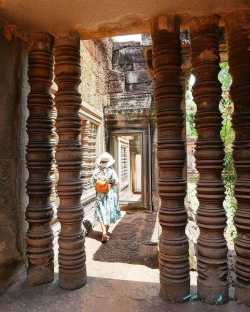
The decoration has also been weathered. APSARA notes that lintels and carved details have suffered erosion, while octagonal colonnettes remain visible at doorways. On site, these fragments are not isolated ornaments; they belong to an architectural scheme that combined enclosure, gates, towers and subsidiary buildings. The open spaces between them help reveal the way visitors approached the central platform. Viewing the temple as a designed compound makes its surviving elements more legible than treating the three towers as separate objects.
Tonle Sap, views and present-day use
The setting adds a second layer to the visit. The Ministry of Tourism says the summit offers views toward Tonle Sap to the west, rice fields and Siem Reap in the distance; it also describes sunrise to the east and sunset over the lake side. These are landscape observations, not a guarantee of clear skies or a perfect view on every day. Weather, haze and seasonal water levels affect what can be seen. The lake itself is an important part of Cambodia’s environment and livelihoods, so the panorama connects an Angkorian monument with a living water landscape.
Phnom Krom is also part of contemporary visitor planning. The Ministry’s report describes APSARA organizing a circuit at the temple, and APSARA’s February 2026 update lists Phnom Krom among sites where a visitor circuit has already been introduced. The authority says these routes use visitor facilities and interpretation to explain temple history, attractions and recommended visit times. That development supports a more deliberate visit, though it does not guarantee every interpretive sign or service will be available on a particular day.
The temple is an active heritage place within the broader Angkor region, not an empty stage. Residents live and work around the lake and the route to the hill; boats and local activity form part of the surrounding landscape. Treat the site respectfully, avoid disrupting worship or local routines, and take waste back with you. The reward is a perspective less focused on Angkor Wat’s central crowds: the hilltop lets the visitor see how monuments, water, fields and settlements make up one connected region.
Opening hours, tickets and preparation
APSARA’s site profile lists Phnom Krom as open from 6:00 a.m. to 7:00 p.m. and suggests about 20 to 30 minutes for a basic temple visit. This is the authority’s published listing, but hours and access conditions can change; confirm before travelling, especially if planning sunrise or sunset. Angkor Enterprise sells official Angkor Archaeological Park passes and currently lists prices of US$37 for one day, US$62 for three days and US$72 for seven days. Check the official ticket site to confirm that your route and date are covered and to see current closing arrangements.
The hill is about 12 kilometres from Siem Reap, but a reliable public-transport timetable to the entrance was not confirmed in the official sources reviewed. Arrange transport in advance or ask your accommodation about a driver, and agree on a return pickup if you are not driving. If combining the temple with a Tonle Sap visit, verify boat departures and lake conditions separately; the archaeological site and a lake excursion are different activities, even when planned on the same day.
Wear shoes with grip for the ascent and uneven stone, carry water, and protect yourself from sun and heat. The site is exposed, and a steep walk can feel demanding in hot weather. Stay within marked routes, do not climb on fragile masonry, and keep away from conservation work. Phnom Krom is best approached as more than a viewpoint: first read the three towers and their enclosure, then look outward to the lake and plain. That sequence joins the temple’s religious purpose to the landscape that still shapes life around Siem Reap.