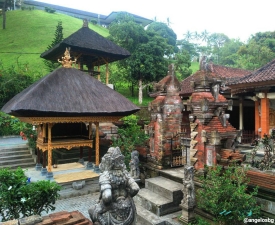
About Banteay Samre
A quieter temple east of the East Baray
Banteay Samre stands east of the embankment that formed the eastern edge of the East Baray, the great reservoir in the Angkor region of Cambodia. The APSARA National Authority places it slightly away from the best-known temple route, reached through countryside of villages and rice fields. That setting is part of its appeal: the approach moves from the busy core of Angkor toward a more open agricultural landscape, without making the monument any less connected to the Khmer capital.
APSARA dates the temple to the middle of the 12th century, shortly after Angkor Wat, and identifies it with the reign of Suryavarman II. The Ministry of Tourism describes the temple as Hindu and associated with Vishnu, while APSARA’s temple account discusses its Hindu character and its architectural relationship to Angkor Wat. These sources agree on the broad period and style; inscriptions are less abundant than at some other Angkor monuments, so the building itself carries much of the historical evidence.
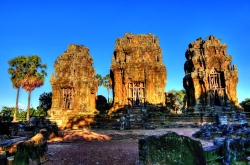
The name Banteay Samre is connected in APSARA’s account with the Samre people. The monument is known for balanced proportions and carefully worked sandstone and laterite. Instead of approaching it as a miniature copy of Angkor Wat, it is more accurate to see a distinct temple whose design belongs to the same architectural moment. Its compact plan, enclosing walls and richly carved surfaces reward a slower look than a quick stop for photographs.
Pediments, stories and a layered religious world
The temple’s pediments are among its strongest visual features. APSARA notes an unusually broad range of mythological scenes and identifies episodes from the Vessantara Jataka among carvings on the upper levels. The Jataka belongs to Buddhist storytelling, while Banteay Samre is described as a Hindu temple. The coexistence of different narrative references is one reason APSARA has discussed the monument in terms of a complex religious environment rather than a simple single-label story.
Carving is not limited to one isolated panel. It appears across pediments, lintels, doorways and architectural frames, so the visitor can read decoration as part of the building’s structure. Look for how a doorway organizes the view into the sanctuary and how images sit within the temple’s balanced composition. Some figures and motifs have weathered or been damaged; their present condition is also a reminder that conservation is continuous work, not a one-time restoration.
APSARA also describes a stone tank with a perforation in its upper surface and a drainage channel below, restored and placed in a large room near the central sanctuary. The authority suggests it may have been used in a ritual involving the periodic washing of remains, but presents this as an interpretation. It is a useful example of how archaeologists connect an object’s shape and placement with possible practice while keeping the limits of certainty visible.
Repairing a monument while keeping it legible
Banteay Samre has undergone extensive restoration, including work using anastylosis: fallen or displaced original stones are documented, conserved and returned to their appropriate positions where evidence allows. The technique aims to stabilize the structure while retaining historic material. A temple that appears visually coherent today is therefore also the result of careful recording, engineering and decisions about how much to reconstruct.
Recent APSARA updates show that conservation remained active in 2025 and 2026. A project begun in early 2025 addressed damage to the southwest section of the front terrace, including deteriorated stone, shifted pillars and foundation problems. In February 2026, APSARA and Germany’s GIZ reported work on the Naga balustrade of the eastern terrace, with a target for completion around mid-year. APSARA specialists also took part in expert inspections of restoration projects in June 2026.
As checked on 7 October 2026, I found the February update’s completion target but no official public confirmation that every listed operation had finished. A target date is not proof of completion, and repairs can affect particular walkways without closing the entire temple. Visitors should follow current barriers and ask APSARA or the Angkor ticket office about access restrictions before traveling. This distinction keeps dated conservation information useful without presenting it as a live status report.
Hours, Angkor tickets and a thoughtful route
APSARA’s Banteay Samre page lists opening hours of 7:30 a.m. to 5:30 p.m. and suggests about an hour for a visit. Angkor Enterprise’s official ticket portal lists the wider park’s entry window as 5:00 a.m. to 6:30 p.m.; that is the park-level window, not a promise that every temple is accessible throughout it. The temple is part of the Angkor Archaeological Park ticket system, so check current pass rules and any site-specific closure before setting out.
On 7 October 2026, Angkor Enterprise listed a one-day Angkor pass at US$37 and a three-day pass at US$62, with the latter valid over seven days. The ticket authority says it is the only place to buy valid passes; its office is on Road 60, around four kilometres from central Siem Reap. Prices and ticket conditions can change, so treat these as dated official listings and verify them again at the time of purchase.
The route to Banteay Samre is a chance to notice the agricultural setting around Angkor, not just the temple walls. Wear comfortable footwear, bring water and sun protection, and leave enough time to walk the approach and examine carved details without touching them. Do not climb on the structures or cross barriers around repair work. The monument’s quiet scale, balanced architecture and conservation story make it a rewarding complement to Angkor’s larger, more familiar sites.