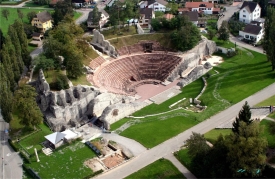
Vindonissa lies around present-day Windisch and Brugg in Switzerland’s canton of Aargau, near the confluence of the Aare, Reuss and Limmat rivers. The setting mattered long before the Roman army arrived: the canton’s archaeological service links the area to a Celtic settlement controlling an important route through the region. Roman forces established a military post here during Augustus’s Alpine campaign in 15 BC. Under Tiberius, between AD 14 and 37, the post developed into a legionary camp. The modern landscape still contains traces of that transformation, although not every ancient feature is visible above ground.
Vindonissa is identified by the canton as the only Roman legionary camp on the territory of modern Switzerland. That distinction gives the site a national importance, but it is not a single ruin enclosed behind a museum wall. Its remains are distributed across Windisch, Brugg and neighbouring communities, woven into a landscape that continued to be occupied and rebuilt. A visitor encounters an archaeological site in an inhabited area, not a frozen Roman town preserved intact.