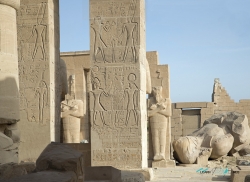
Kom Ombo Temple stands on the east bank of the Nile in the town of Kom Ombo, in Egypt’s Aswan Governorate. Its position on a rise above the river makes the site easy to recognise from the surrounding landscape, but the building’s plan is what sets it apart. Rather than organising worship around one central axis, the temple has two parallel routes through its columned halls, ending at separate sanctuaries. The Ministry of Tourism and Antiquities describes the southern axis as belonging to Sobek and the northern one to Harwer, or Horus the Elder.
The Ministry’s Arabic monument entry offers an interpretation of the place-name: it connects “Kom” with the Arabic word for a mound and traces “Ombo” to the ancient Egyptian name Nubt, associated with gold. Such etymologies are useful context, not a substitute for the site’s better-documented history. The same ministry notes that an earlier temple stood here during the New Kingdom, while the surviving complex belongs mainly to the Greco-Roman era. The first attested royal name is Ptolemy VI Philometor, who ruled from 180 to 145 BCE; much of the decoration was completed under Ptolemy XII in the first century BCE.