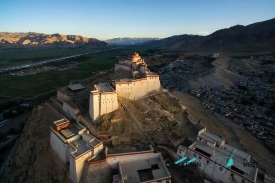
Majestic and mystical, the Potala Palace rises on the red hill of Marpo Ri, in the heart of Lhasa, at an altitude of more than 3,700 meters. Its silhouette dominates the Lhasa river valley and its history is deeply linked to Tibetan spirituality. Built from 1645 by order of the fifth Dalai Lama, the Potala became the official residence of Tibet's spiritual leaders until 1959. The name "Potala" comes from Mount Potalaka, the mythical abode of the bodhisattva Avalokiteśvara, symbol of universal compassion. In 1994 it was declared a UNESCO World Heritage Site, and today it remains one of the most revered and admired monuments in the world. The White PalaceThe White Palace, or Potrang Karpo, is the residential and administrative part of the complex. Its construction began during the rule of the fifth Dalai Lama, who moved his government to Lhasa in 1649. At the beginning of the 20th century, the thirteenth dalai lama enlarged the building to its present dimensions, preserving the elegance and spiritual symbolism that characterize it. Unlike the Red Palace, the White Palace has always had a secular and governmental use: it housed offices, the Dalai Lama's quarters, a seminary and a monastic printing press.At the heart of the complex is the yellow-painted Deyangshar courtyard, which acts as a boundary between the political and religious spheres. This space connects the residential quarters of the Dalai Lama with the Red Palace, dedicated entirely to prayer and the study of Buddhism. Inside the White Palace, priceless treasures are preserved: the golden stupa of the eighth Dalai Lama, the assembly hall, numerous chapels, shrines and libraries containing sacred texts such as the Kangyur, with 108 volumes, and the Tengyur, with 225 written in golden ink. The adjacent yellow building houses the huge banners with sacred symbols that are displayed during New Year festivals, covering the southern façade with an imposing image of collective devotion. The Red PalaceThe Red Palace, or Potrang Marpo, was built in 1694 under the rule of the sixth Dalai Lama and is dedicated entirely to spiritual life. In contrast to the administrative function of the White Palace, the Red Palace was conceived as an inner temple, dedicated to study, meditation and the preservation of sacred knowledge. Its architectural design, inspired by Indian mandalas, represents the union between the cosmos and the enlightened mind, an essential principle of Tibetan Buddhism.The seven gilded bronze roofs that crown the building house the funerary stupas of the Dalai Lamas, adorned with flowers, bells and ornamental lightning bolts that also serve as lightning rods. Inside lie the embalmed bodies of the ancient spiritual leaders, covered with gold and precious jewels, symbols of purity and eternal wisdom. The walls of the Red Palace are covered with frescoes narrating the life of Buddha and the history of Tibet, while the altars display thousands of statues, offerings and prayer scrolls.During the conflicts of the 20th century, the Potala suffered the effects of the 1959 bombing, when the 14th Dalai Lama fled to India. Although some sections were damaged, the structure withstood and was later restored with meticulous respect for its authenticity. In 1989 and again in 2002, comprehensive restorations were carried out under the principle of "repair without alteration" to preserve the original harmony of the ensemble intact.Today, the Potala Palace is a symbol of cultural and spiritual resistance, a masterpiece that fuses religious devotion with architectural grandeur. With its more than 1,000 halls, 10,000 altars and 200,000 statues, it remains the spiritual heart of Tibet and one of the holiest places in Asia. Its image, silhouetted against the Himalayan mountains, continues to inspire those who seek inner peace and the living memory of an ancient civilization within its walls. Tips for visiting the Potala Palace:Location: Lhasa, Tibet Autonomous Region, China. Altitude: 3,750 m above sea level. Best time to visit: May to October, when the weather is milder. Admission: Visits are limited per day; advance reservations are recommended.The Potala Palace represents not only an architectural feat, but also a symbol of balance between power, faith and culture. Its greatness lies in having been, for centuries, the bridge between the earthly and the divine.To visit it is to enter the spiritual heart of Tibet, where history, religion and beauty are intertwined in the same destination.