ABOUT Kuhikugu
Kuhikugu: The Lost Amazonian Cities Rewriting the History of the Rainforest
Deep in the southern Amazon rainforest, at the headwaters of Brazil’s Xingu River, lies one of the most transformative archaeological discoveries of the past quarter century. Known as Kuhikugu, this network of ancient settlements is forcing researchers to rethink what once existed in the world’s largest tropical forest. Far from being an untouched wilderness populated only by small, scattered groups, the Amazon was home to large, interconnected Indigenous cities, engineered landscapes and sophisticated systems of agriculture, defense and aquaculture.
Today, these lost cities sit within the Xingu Indigenous Territory, protected in part thanks to the Kuikuro people — descendants of the original inhabitants — who guided archaeologists to the ruins and continue to share crucial cultural knowledge.
A Hidden Urban World in the Heart of the Forest
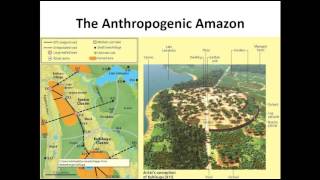
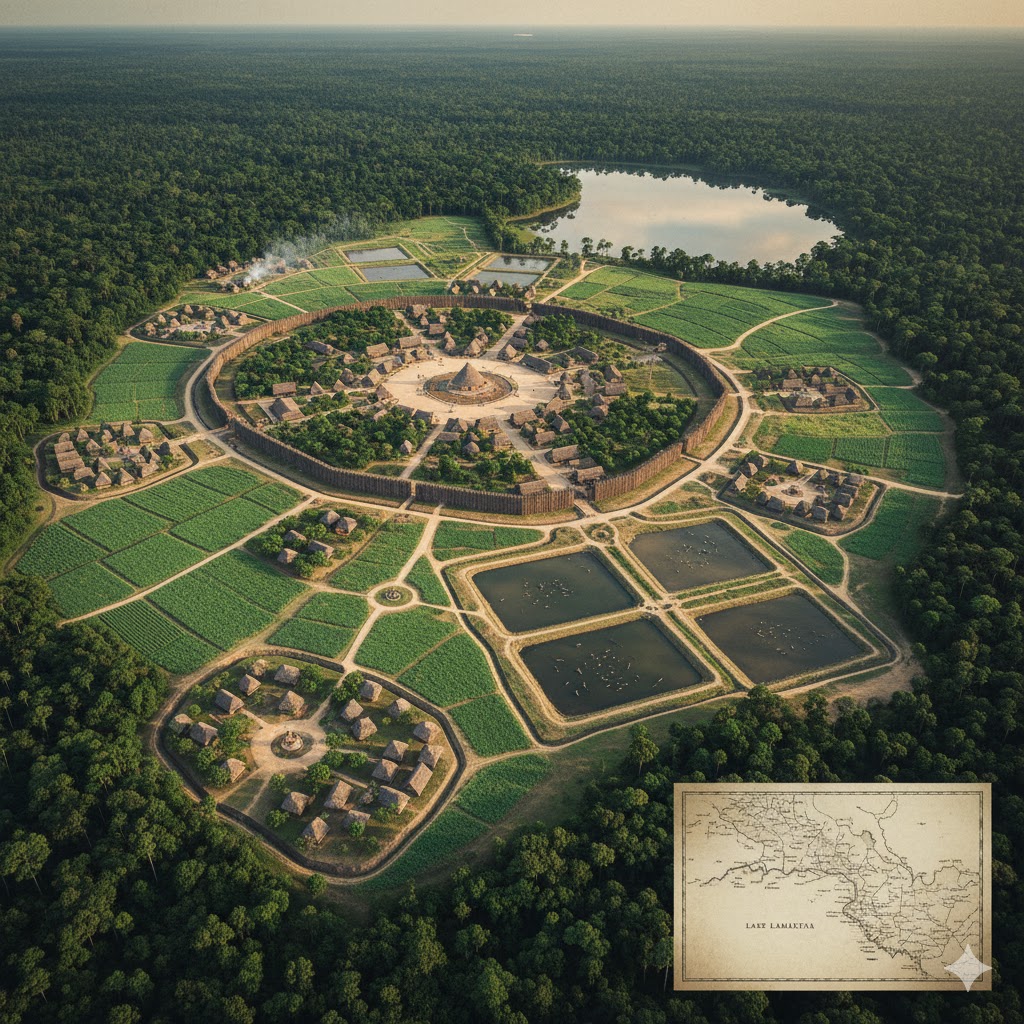
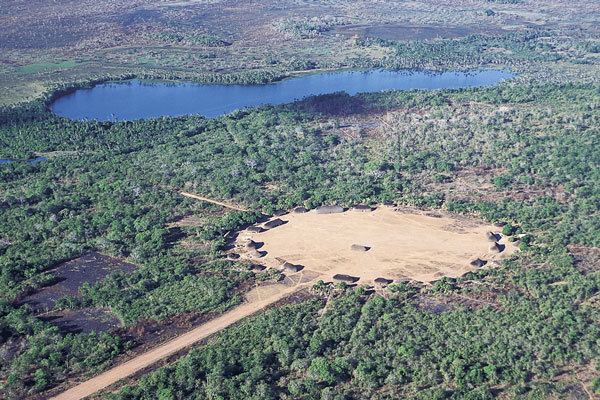
Kuhikugu is not a single archaeological site but a complex of more than twenty large villages, connected by straight, carefully planned roads. The settlements once stretched across up to 20,000 square kilometers, forming a political and ceremonial landscape on a scale few imagined possible for pre-Columbian Amazonia.
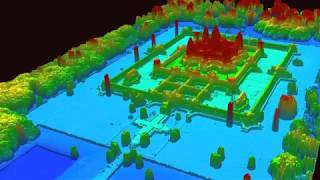
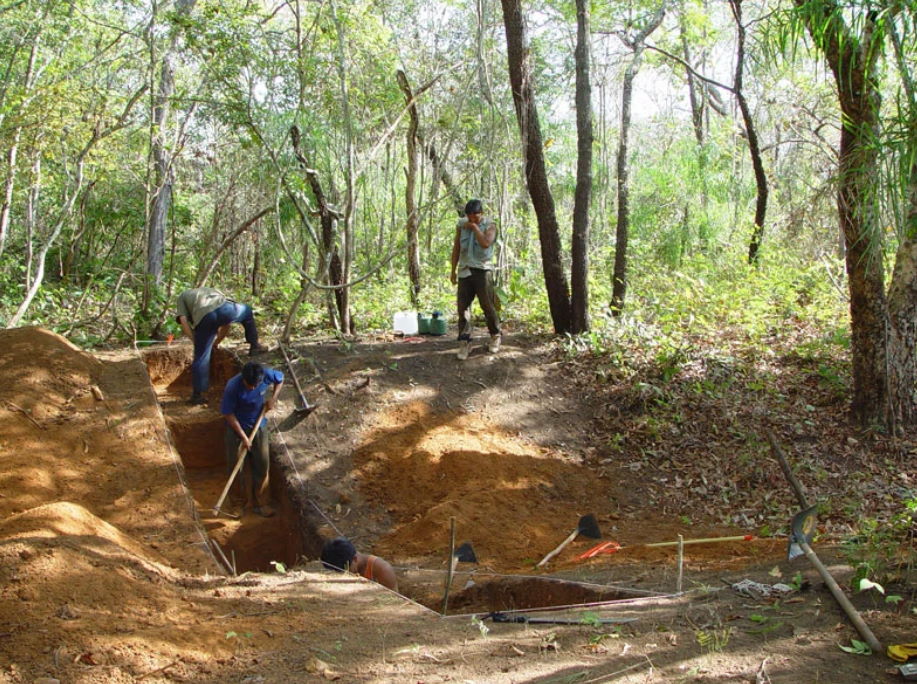
Using satellite imagery, GPS and more recently LIDAR technology, researchers have revealed:
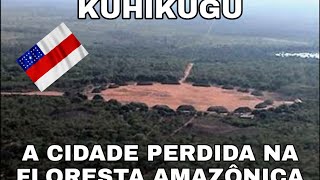
Circular plazas at the center of each village
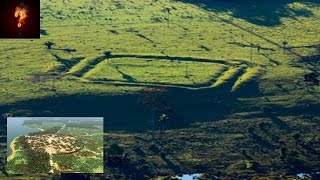
Massive wooden palisades and defensive ditches
Long-distance roads as wide as modern highways
Agricultural fields, orchards and raised areas
Artificial ponds and sophisticated fish-farming systems
Together, they form a picture not of isolated tribes but of a regional urban network, active until around four hundred years ago.
Up to 50,000 People in a Managed Amazonian Landscape
At its peak, the Kuhikugu complex may have supported 30,000 to 50,000 inhabitants. The population was not concentrated in a single metropolis like the Inca or Aztec capitals. Instead, the settlements functioned as a system of interconnected villages, each with its own plaza, communal structures and defensive works, yet all linked into a larger political entity.
The largest settlement — likely a regional capital — may have housed around 5,000 people, surrounded by palisades designed to repel rival groups.
Daily life relied on a carefully engineered landscape. Fields of cassava, fruit orchards and managed forests provided carbohydrates and plant foods. Meanwhile, the region’s lakes and streams supported a remarkable form of Indigenous aquaculture: residents built earthen dams, weirs and controlled ponds to raise and manage fish. This practice continues among several Xingu Indigenous groups today.
An Urban Civilization Erased by Invisible Enemies
If Kuhikugu was so extensive, why did European explorers never document it?
The answer lies in timing. By the time colonists reached the region in the 16th and 17th centuries, epidemics had already swept through the interior, carried along trade networks long before direct contact. Diseases like smallpox and measles devastated Amazonian populations, reducing communities by as much as 90 percent within decades.
With so few survivors and the forest quick to reclaim abandoned land, cities that once resonated with thousands of voices were swallowed by vegetation. Explorers traveling through the Xingu encountered only small, dispersed villages — unaware that beneath the canopy lay the remains of a lost urban world.
A New Chapter in Amazonian Archaeology
The discovery of Kuhikugu has reshaped global debates on the ancient Amazon. It supports a growing body of evidence that large parts of the rainforest were once intensively managed landscapes, shaped by Indigenous engineering rather than untouched wilderness.
For the Kuikuro, the research confirms what oral histories have long preserved. For scientists, Kuhikugu demonstrates that Amazonian societies developed complex urban planning, ecological knowledge and political organization adapted perfectly to their environment.
But the story is far from complete. Continuous excavations, ethnographic collaboration and new imaging technologies promise to reveal even more about these ancient cities — and about the people whose descendants still call the Xingu home.
The Amazon Was Never Empty — We Are Only Beginning to Understand It
Kuhikugu stands as a powerful reminder that the Amazon’s past is far richer than the myths of pristine jungle or primitive isolation. Long before outsiders arrived, this region supported thriving, interconnected civilizations, whose environmental ingenuity offers valuable lessons for the planet today.
As scholars continue to unearth traces of this remarkable society, one thing is clear: the story of the Amazon is not just one of forests, but of cities — and Kuhikugu may be one of the most extraordinary ever found.
Deep in the southern Amazon rainforest, at the headwaters of Brazil’s Xingu River, lies one of the most transformative archaeological discoveries of the past quarter century. Known as Kuhikugu, this network of ancient settlements is forcing researchers to rethink what once existed in the world’s largest tropical forest. Far from being an untouched wilderness populated only by small, scattered groups, the Amazon was home to large, interconnected Indigenous cities, engineered landscapes and sophisticated systems of agriculture, defense and aquaculture.
Today, these lost cities sit within the Xingu Indigenous Territory, protected in part thanks to the Kuikuro people — descendants of the original inhabitants — who guided archaeologists to the ruins and continue to share crucial cultural knowledge.
A Hidden Urban World in the Heart of the Forest
Kuhikugu is not a single archaeological site but a complex of more than twenty large villages, connected by straight, carefully planned roads. The settlements once stretched across up to 20,000 square kilometers, forming a political and ceremonial landscape on a scale few imagined possible for pre-Columbian Amazonia.
Using satellite imagery, GPS and more recently LIDAR technology, researchers have revealed:
Circular plazas at the center of each village
Massive wooden palisades and defensive ditches
Long-distance roads as wide as modern highways
Agricultural fields, orchards and raised areas
Artificial ponds and sophisticated fish-farming systems
Together, they form a picture not of isolated tribes but of a regional urban network, active until around four hundred years ago.
Up to 50,000 People in a Managed Amazonian Landscape
At its peak, the Kuhikugu complex may have supported 30,000 to 50,000 inhabitants. The population was not concentrated in a single metropolis like the Inca or Aztec capitals. Instead, the settlements functioned as a system of interconnected villages, each with its own plaza, communal structures and defensive works, yet all linked into a larger political entity.
The largest settlement — likely a regional capital — may have housed around 5,000 people, surrounded by palisades designed to repel rival groups.
Daily life relied on a carefully engineered landscape. Fields of cassava, fruit orchards and managed forests provided carbohydrates and plant foods. Meanwhile, the region’s lakes and streams supported a remarkable form of Indigenous aquaculture: residents built earthen dams, weirs and controlled ponds to raise and manage fish. This practice continues among several Xingu Indigenous groups today.
An Urban Civilization Erased by Invisible Enemies
If Kuhikugu was so extensive, why did European explorers never document it?
The answer lies in timing. By the time colonists reached the region in the 16th and 17th centuries, epidemics had already swept through the interior, carried along trade networks long before direct contact. Diseases like smallpox and measles devastated Amazonian populations, reducing communities by as much as 90 percent within decades.
With so few survivors and the forest quick to reclaim abandoned land, cities that once resonated with thousands of voices were swallowed by vegetation. Explorers traveling through the Xingu encountered only small, dispersed villages — unaware that beneath the canopy lay the remains of a lost urban world.
A New Chapter in Amazonian Archaeology
The discovery of Kuhikugu has reshaped global debates on the ancient Amazon. It supports a growing body of evidence that large parts of the rainforest were once intensively managed landscapes, shaped by Indigenous engineering rather than untouched wilderness.
For the Kuikuro, the research confirms what oral histories have long preserved. For scientists, Kuhikugu demonstrates that Amazonian societies developed complex urban planning, ecological knowledge and political organization adapted perfectly to their environment.
But the story is far from complete. Continuous excavations, ethnographic collaboration and new imaging technologies promise to reveal even more about these ancient cities — and about the people whose descendants still call the Xingu home.
The Amazon Was Never Empty — We Are Only Beginning to Understand It
Kuhikugu stands as a powerful reminder that the Amazon’s past is far richer than the myths of pristine jungle or primitive isolation. Long before outsiders arrived, this region supported thriving, interconnected civilizations, whose environmental ingenuity offers valuable lessons for the planet today.
As scholars continue to unearth traces of this remarkable society, one thing is clear: the story of the Amazon is not just one of forests, but of cities — and Kuhikugu may be one of the most extraordinary ever found.
The Best Pictures of Kuhikugu
Videos of Kuhikugu