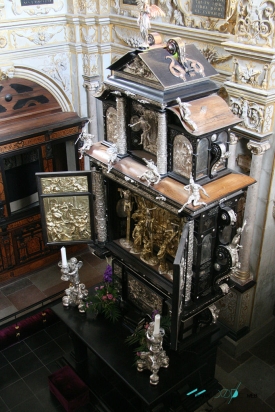
At the edge of Helsingør, where Denmark nearly touches Sweden across the Øresund, Kronborg Castle occupies a position that explains its history before a visitor enters the gate. The fortress commands the narrow passage between the North Sea and the Baltic, and for centuries that location gave Denmark a powerful role in northern European trade and politics. Today Kronborg is a UNESCO World Heritage site, a Renaissance castle and the Elsinore made famous by Shakespeare. These stories overlap, but the historical fortress is more than a literary setting.
In the 1420s, King Eric of Pomerania built a fortress called Krogen at the strategic site. In 1574, King Frederik II began a major reconstruction that transformed it into a Renaissance castle. UNESCO describes a four-winged building around a courtyard, with sandstone ornament, towers and a large banqueting hall. The new palace was completed in 1585 and renamed Kronborg. Its architecture was meant to project royal authority to ships crossing the Sound, while its fortifications made clear that the castle was also a working military installation.