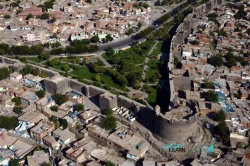
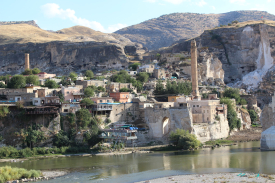
Far out in the dry plain that stretches between the city of Şanlıurfa and the Syrian border, where the air shimmers above the wheat fields and the call to prayer drifts across one of the oldest continuously inhabited places on earth, Harran Castle rises from the southeast corner of an ancient walled town. Modest in its present ruined state but vast in historical resonance, the castle stands at the heart of a settlement whose name appears in the Bible, in Mesopotamian cuneiform tablets, in the genealogies of the Prophet Abraham, and in the foundational texts of Islamic astronomy. For travellers willing to journey to Turkey's deep southeast, Harran offers a layered encounter with civilization itself, and the castle is the moody, monumental anchor of that encounter.
The fortress sits within the old walled city, surrounded by the celebrated beehive-shaped mud-brick houses for which Harran is famous, and overlooked by the slender square minaret of the Ulu Cami, the Great Mosque, often described as the first purpose-built mosque on Turkish soil.