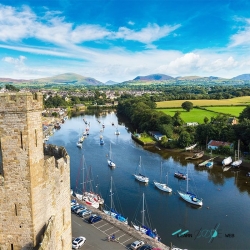
Harlech Castle, known in Welsh as Castell Harlech, rises from a steep rocky outcrop above the town in north-west Wales. The view takes in the broad coastal plain, dunes and the mountains of Eryri, formerly called Snowdonia in English. The shoreline that once gave the fortress direct access to the sea has shifted, leaving the castle visibly separated from the water. That change makes the setting more than a dramatic backdrop: it helps explain why the site was chosen and how its strategic geography is read today.
King Edward I ordered the castle during his conquest of Wales. Work began in 1282 and the fortress was completed in 1289, under the direction of Master James of St George, the king’s leading military architect. Cadw describes the result as a compact design of “walls within walls,” protected by the steep slopes and a strong inner ward. Harlech was one element in a wider programme of royal strongholds, not an isolated medieval palace. Its stonework makes the political purpose legible: a powerful crown placed a permanent military presence in a region resisting English rule.