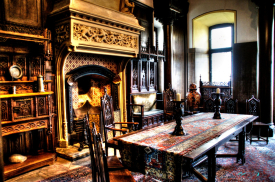
Northwest of Mayen in Germany's Eifel region, Bürresheim rises above the Nette valley with pointed roofs, half-timbering and a compact cluster of stone buildings. Its picturesque outline can suggest a fairy tale, but the reason to look closely is historical. The Rhineland-Palatinate heritage authority says the complex was never destroyed and remained inhabited until 1938. Furniture, portraits and rooms therefore record a long residential life instead of an imagined medieval scene rebuilt from fragments. The castle is both a former stronghold and an unusually continuous domestic archive.
That continuity was not the result of an unchanging building. The state cultural portal dates its architectural development from the twelfth to the seventeenth century. It distinguishes an older Cologne castle from a Trier castle, names that reflect the influence of two electoral territories. Over time, the Cologne portion became a service area, while the Trier side continued to be occupied and adapted. The surviving group is a record of changing needs: defense, status, household management and comfort made different demands on the same rocky site.