Wembley Stadium: a century of football, live events and how to visit
A stadium that became part of London’s story
Wembley Stadium is more than a football ground. In north-west London, it is a national venue for sport, music and large public occasions, and its name carries a century of associations. The present stadium stands on the site of the original Empire Stadium, near Wembley Park and the wider Wembley regeneration district. On an event day, tens of thousands travel to the area; on a tour day, visitors can look behind the scenes. Either way, the place is best understood as a working venue whose schedule changes with the calendar.
The first Wembley Stadium was built as the centrepiece of the British Empire Exhibition planned for 1924–25. It opened on 28 April 1923, when it hosted the FA Cup Final between Bolton Wanderers and West Ham United. The match became known as the “White Horse Final” after mounted police, including the white horse Billy, helped clear the pitch of spectators before kick-off. That unusual beginning became part of the ground’s mythology, but it also established Wembley as a stage for shared national events beyond the ordinary rhythm of league football.
The old stadium’s twin towers became one of English football’s most recognizable images. Wembley’s official centenary history records how the venue hosted the England team and FA Cup finals, but its calendar reached well beyond football: it was a principal venue for the 1948 Olympic Games, welcomed major rugby and boxing events, and became a landmark concert location. Live Aid in 1985 is one of the best-known examples. This breadth matters to visitors today, because the identity of Wembley is shaped by many audiences and event traditions, not only by one club or sport.
From the Empire Stadium to the modern arch
The original ground closed after its final football match in 2000, and its twin towers were demolished in 2002 as the site was rebuilt. The current stadium opened in 2007, again with an FA Cup Final as its first major event. Its architecture makes a decisive break with the old towers: the sweeping arch rises above the North Stand and has become a visible marker across the London skyline. Wembley’s official history describes today’s stadium as a 90,000-seat venue, a scale that helps explain its ability to stage events for a very large audience.
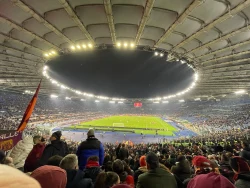
The arch is not merely a decorative symbol. Stadium information describes it as a major structural element supporting the roof, with a height of 133 metres at its highest point and a span of 315 metres. The roof covers the seating bowl, though it does not close completely over the playing surface. These engineering details help explain why the building looks different from a traditional open football ground. They also show how the modern Wembley was designed to combine sightlines, weather protection and the technical requirements of concerts and other productions.
Today the venue hosts England men’s and women’s senior teams, major domestic finals, international football, concerts and other events. The exact calendar is never fixed: a stadium visit may coincide with a match, a concert build, a private event or a quiet day between productions. This is why a photo of the arch tells only part of the story. The bowl, concourses, changing rooms and event infrastructure are used differently from one booking to another, and access to particular areas depends on what is happening at the time.
What the stadium tour reveals
The official Stadium Tour is designed to show areas usually reserved for performers, players and staff. Its visitor information describes a combination of self-guided sections and a host-led route through more secure parts of the building. Depending on operational access, the tour can take visitors through spaces associated with the teams, the pitch and the Royal Box; no route should be treated as guaranteed for every date. The guided portion lasts about 75 minutes, and the operator recommends allowing roughly two hours for the full visit, including the multimedia sections.
The tour support page, checked on October 8, 2026, lists opening from 10 a.m. and seasonal last-entry times: 3 p.m. from October to March, 4 p.m. from April to July and September, and 5 p.m. in August. The page was last revised in May 2024, so visitors should confirm the live date-and-time calendar before travelling; an event or stadium operation can alter access. The entrance is on Level 1 behind the Bobby Moore Statue. Visitors go through a bag search, and large bags or suitcases are not allowed; there is no cloakroom.
Multimedia guides are provided for the self-guided portions, with content in English, French, Spanish, German, Mandarin and British Sign Language. The tour host leads the group through restricted areas, while the guide supplies audio or visual translation and supporting media. Stadium accessibility information says the tour is suitable for wheelchair users, with an alternative route to the Royal Box where steps prevent direct access. Accessible toilets are available; dark spaces, strobe lighting and sound effects are also part of some areas, so guests who wish to avoid them can alert staff.
Getting there and planning around an event
Wembley is served by three stations: Wembley Park on the Jubilee and Metropolitan Underground lines, Wembley Stadium on Chiltern Railways, and Wembley Central on the Bakerloo line and London Overground. The stadium’s current travel guidance recommends checking real-time transport information and leaving enough time for onward connections. Event-specific coach services may also run. Public transport is usually the most practical choice on a major event day, when local roads, queues and station access can be affected by crowd management.
For a tour, follow the booking confirmation for the exact entrance and arrival time, and check the stadium’s live visitor page before setting out. If you need step-free access, sensory information or a specific route, contact the venue in advance rather than assuming every part of the stadium has the same conditions. Tour schedules, prices and available areas can change, and the visitor-support pages are operational guidance rather than a permanent guarantee. The Stadium Tour does not include entry to a live match or concert unless the ticket expressly says so.
Wembley’s appeal comes from the contrast between its scale and the small human moments that have accumulated there: a final, a goal, a concert, a walk into the Royal Box or a view of the pitch from the stands. Visitors interested in history can connect the present arch with the 1923 ground and its “White Horse Final”; sports fans can place the stadium within the story of England and the FA Cup; concertgoers can recognize a venue built for a different kind of crowd. Check the event calendar, allow time for travel and let the day’s actual access shape the visit.