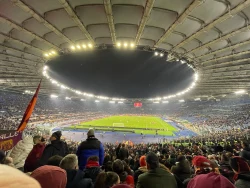
Beijing National Stadium: inside the Bird’s Nest and its Olympic story
From a distance, Beijing National Stadium looks less like a conventional arena than a giant nest of steel laid across the Olympic Green. The nickname Bird’s Nest, or Niaochao, has become more familiar than its formal name, but the building is not a sculpture placed beside a sports field: its interlaced structure wraps a bowl designed for tens of thousands of spectators. For visitors, that contrast between monumental exterior and working interior is the starting point for understanding the site.
The stadium stands in the central area of Beijing Olympic Park. Its official profile gives a capacity of about 91,000, a building area of 258,000 square metres and a site area of 20.4 hectares. The oval structure rises to roughly 69 metres. Construction began in December 2003, and the venue was completed in June 2008, just before the city hosted the Summer Games. These figures explain why the Bird’s Nest dominates the park’s skyline, but the impression becomes clearer on foot: the steel frame changes in appearance as a visitor moves around the building.
A design that makes structure visible
The project was developed by the Swiss architecture team Herzog & de Meuron with Chinese partners at the China Architecture Design and Research Group. Artist Ai Weiwei also served as an artistic consultant during the design process. Rather than hide the engineering behind a smooth façade, the design turns the outer steel members into the building’s defining image. The overlapping lines appear irregular, yet they surround a carefully organized seating bowl, circulation spaces and event facilities.
The name came from the resemblance of the steel lattice to a bird’s nest. It is an easy comparison to recognize in photographs, but the effect is more layered in person: the scale, shadows and gaps between the beams shift with the light. The stadium is an important part of the Olympic Green, where several venues from different Games share a broad urban landscape. It is worth looking at the exterior from more than one side rather than treating a single photograph as the whole experience.
Two Olympic eras in one venue
The Bird’s Nest became one of the principal stages of the Beijing 2008 Olympic and Paralympic Games. The opening and closing ceremonies made it visible to a worldwide audience, while the stadium also hosted athletics and football matches. Its role was therefore both practical and symbolic: it held competitions, but its silhouette also became a shorthand for the city’s Olympic transformation.
Fourteen years later, the same stadium returned to the center of another global event. It hosted the opening and closing ceremonies of the Beijing 2022 Winter Olympics and Paralympics, making it the first venue to stage opening and closing ceremonies for both a Summer and a Winter Olympic Games. The return required a new ceremonial setting rather than a repeat of the 2008 spectacle. Together, the two editions give the building a rare continuity: a sports arena that has repeatedly served as a public image of Beijing.
Between and after the Games, the venue has been used for competitions, concerts and large public events. That ongoing program matters to anyone planning a visit. A stadium in active use is not a museum that opens on an unchanging timetable; rehearsals, performances and event preparation can affect access, visitor routes and the hours available for sightseeing.
What visitors can see
The official sightseeing route is designed to bring visitors inside the structure, not merely to view it from the park. The stadium’s visitor guide describes the west entrance and the Golden Hall, as well as displays linked to the two Olympics, their ceremonies and the building’s construction. The experience helps translate a famous exterior into interior scale: ramps, concourses, seating and the open span of the roof reveal how the architecture serves the crowd.
The route and accessible areas may change according to the stadium’s event schedule. Visitors should distinguish a general sightseeing admission from a ticket to a concert or sports event; neither automatically guarantees the other. If the main aim is photography, allow time to walk around the exterior before or after the interior visit. The Bird’s Nest is also close to the National Indoor Stadium, a different building with a different history and its own event calendar, so check the venue name on any ticket.
Hours, tickets and practical planning
As checked on 3 October 2026, the stadium’s official English visitor page lists a standard day-tour window of 10 a.m. to 10 p.m., with last entry at 9 p.m. An official notice in July 2026 documented temporary shorter hours around concert dates before stating that full-day opening resumed from 13 July. That notice is a useful reminder: schedules can change again for later events. Before travelling, consult the Bird’s Nest’s own visitor and ticket pages or call its national service line, 400-600-2008, to confirm the day’s route, admission and any restrictions.
Plan for security checks and a large site. A timed event ticket and a sightseeing ticket serve different purposes, and the official sales channel is the safest place to confirm what a particular ticket includes. The stadium is in the Olympic Park, where outdoor walking is part of the visit; weather, crowd controls and event barriers may change the best approach. If you hope to see an exhibition as well as the arena, check that it is included in the route offered on your date.
The Bird’s Nest rewards a slower visit. Its Olympic story is familiar, but the building is most legible when its structural image is connected to the people who fill the bowl, the ceremonies that turned it into a global symbol and the everyday logistics that keep a major venue operating. Seen that way, the steel web is not just a memorable outline against Beijing’s sky; it is an adaptable piece of civic infrastructure still being used long after the flame went out.