San Siro Stadium in Milan: football history, tours and the stadium’s uncertain future
San Siro is not simply the ground where Milan’s two football clubs meet. Its concrete tiers, red roof beams and steep approach have made the Stadio Giuseppe Meazza one of the most recognizable landmarks in the city. AC Milan and Inter share the stadium, while its museum and guided visit invite travelers to look beyond match day. In 2026, a new rooftop walk added a different view of the structure, even as municipal plans for a replacement stadium put the Meazza’s long-term future under discussion. Check the live calendar before setting out: events can change both access and visiting hours.
A ground built for Milan
The story began in 1925, when Milan president Piero Pirelli backed a purpose-built football ground near the city’s trotting track. Designed by architect Ulisse Stacchini, the original stadium took about thirteen months to complete and held roughly 35,000 spectators. It opened on 19 September 1926 with a Milan–Inter derby, won 6–3 by Inter. At first it was Milan’s home; in 1935 the municipality bought the site and began expanding it. Four curved sections joined the stands, raising capacity to about 55,000 and giving the ground a more enclosed shape.
Inter became a regular co-tenant from the 1947–48 season. A second tier, added in the 1950s, transformed the stadium’s scale and brought its stated capacity at the time to about 85,000. In 1980 it was officially named for Giuseppe Meazza, the Milan-born forward who played for both clubs and won the World Cup with Italy in 1934 and 1938. Supporters still use both names: “San Siro” ties the venue to its neighborhood, while “Giuseppe Meazza” honors a player whose career crossed the city’s famous rivalry.
Concrete rings and a changing skyline
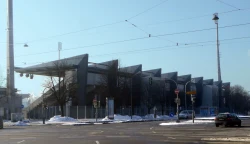
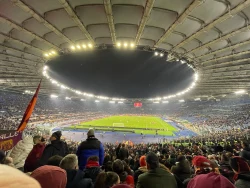
The profile seen today took shape during preparations for the 1990 FIFA World Cup. A third tier and roof were added, along with the stadium’s striking support towers and spiral access ramps. The operator describes a structure carried by four corner towers and seven intermediate towers; the current listed capacity is 75,817. Rather than a uniform bowl, the building reads as a sequence of rings and exposed engineering. From outside, the red steel roof supports make it easy to recognize; inside, the high stands bring spectators close to a field framed by the structure.
San Siro has hosted matches at the 1934 and 1990 World Cups, UEFA Euro 1980 and major European club finals, as well as decades of Milan and Inter fixtures and large concerts. On 6 February 2026 it also hosted the Milan venue of the Milano Cortina Winter Olympics opening ceremony. Those events explain why the stadium is often called “La Scala del Calcio,” or football’s La Scala, but the nickname can obscure its everyday role: it remains a working venue whose routes, gates and nearby streets are organized around the event on that day.
From the museum tunnel to the roof
The Museum&Tour gives visitors a way to experience the stadium outside a match. The official route includes a collection of shirts and memorabilia, the home changing rooms of Milan and Inter, the mixed zone, the players’ tunnel, the pitchside area and the team benches. The exact itinerary can change for operational reasons, so an advertised visit should not be read as a promise that every room will be open on every date. Museum and stadium entry is at Gate 6, beside Piazzale Angelo Moratti; the official ticket calendar is the place to confirm availability and the selected time.
Since 4 May 2026, a separate Skywalk experience has taken visitors onto the stadium roof, along the red beams about 55 metres above the ground. The guided route passes through the roof structure and offers views across Milan toward the Alps. It is a distinct ticket or add-on, not automatically included with a Museum&Tour booking. The operator schedules it seasonally, generally March to October, and may suspend it in strong wind, heavy rain or snow. Closed shoes with rubber soles are required; the roof route is not accessible to people with mobility limitations, and other eligibility restrictions apply. Read the current rules before buying.
Plan around the calendar—and the next chapter
The Museum&Tour is listed as open daily, with standard hours of 9:30 a.m.–6 p.m. from April through October and 9:30 a.m.–5 p.m. from November through March. The entrance and ticket office close at the stated end time. Matches, concerts and other events can shorten the schedule or alter the route, so check the official calendar for the date you want rather than relying on a general weekly timetable. Ticket availability and prices depend on the experience and date; the official site links to online booking and also identifies the Gate 6 ticket office.
For public transport, take metro line M5 to San Siro Stadio; bus 49 and tram 16 also stop nearby. The stadium address is Piazzale Angelo Moratti, 20151 Milan. On event days, follow the instructions on your ticket and the clubs’ or concert organizer’s access information, as gates and traffic arrangements can differ. The city’s long-range plans are another reason to check current notices: Milan sold the stadium complex in 2025 to a company wholly owned by AC Milan and Inter, and its 2026 planning process proposes a new stadium and partial demolition of the Meazza. That proposal is still moving through environmental and planning review, not a confirmed visitor closure date.
For now, San Siro remains both a football venue and a place to read Milan’s sporting history in its architecture. A tour reveals the shared dressing rooms and walk to the pitch; the Skywalk brings the roof into the story; and the city’s current debate makes the visit feel connected to a larger question about what Milan chooses to preserve. Check hours, event restrictions and ticket conditions close to your visit, then allow time to see the stadium from outside as well as within. The building’s scale makes the approach part of the experience.