Monte San Nicola: the Roman sanctuary above Pietravairano
A sanctuary on the mountain crest
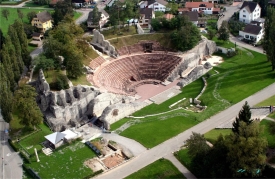
Above the hamlet of Sant’Eremo, the archaeological complex of Monte San Nicola occupies a crest overlooking Pietravairano in Campania. A temple sits on the upper terrace and a semicircular theatre follows the slope below it. The arrangement turns the mountain itself into part of the architecture: the sanctuary is not a detached building in a flat square, but a sequence of built platforms set into a high landscape. The Comune of Pietravairano places the site at about 409 metres above sea level.
The view is part of the experience, but the remains are more than a scenic overlook. The municipality describes the sanctuary as an organized complex of religious and theatrical spaces, constructed with local limestone and other reused material. The theatre’s curved seating area, or cavea, uses the natural incline, while the temple platform was made level with a supporting wall. Archaeologists can still read the layout even where the original elevations and much of the temple’s superstructure have disappeared.
Its remote position raises a useful question for visitors: why place a sanctuary on a ridge rather than in the settlement below? The town’s historical account suggests that the complex served a dispersed rural population and may have had a symbolic role as well as a practical one. That interpretation is not a complete answer, but it links the monument to the surrounding territory, its routes and the communities that used the high ground.
How the temple and theatre fit together
The temple occupies the highest platform, described by the municipality as roughly square and about 22 metres to a side. Its plan is identified as Tuscan, with three cellae and a tetrastyle façade. Those architectural terms describe a building with a front portico of four columns and three internal rooms; the surviving plan lets researchers discuss its design even though the raised portions of the ancient temple are largely gone. A basin and a nearby cistern also point to the practical need to collect and manage rainwater on the ridge.
Lower down, the theatre is set into the southern slope. The municipal description gives the cavea a radius of about 21.5 metres and records twenty surviving seating rows arranged in four wedges by stairways. Its stage building is best preserved at the lower, under-stage level, although parts of the side structures remain visible above ground. Rather than reconstructing a complete theatre from the fragments, a careful visit means noticing the arc of the retaining walls and how the builders used the terrain.
The two structures were aligned across terraces at different elevations, creating a visual and ceremonial connection between sacred space and performance. The Comune describes an archaeological area of just under 3,000 square metres. That compact footprint helps explain why the site is legible from above: temple platform, slope, cavea and stage remain tied to one another. It also means the complex should be treated as a fragile archaeological setting, not as a place to wander off the marked route or climb on masonry.
Rediscovery, excavation and an unresolved date
The modern story began with an aerial view. Nicolino Lombardi, a local historian and flying enthusiast, noticed the semicircular traces while flying over the mountain on 4 February 2000. The Comune’s account says that photographs helped identify the remains as a monumental sanctuary combining a temple and theatre on separate levels. This is a documented modern rediscovery, not a claim that the site had been wholly unknown to every local resident; the same municipal page recalls earlier observations of ruins and a prehistoric fortification on the ridge.
Archaeological campaigns followed in 2002 and, with the University of Salento, during 2005–08 and 2012–14. The excavations exposed the principal remains and refined the complex’s interpretation. A research record in Sapienza University’s repository documents a 2012 campaign. The municipal account’s historical section dates construction to the late Republican period, around the end of the second or beginning of the first century BCE.
There is an important caveat: the same municipal webpage gives a broader and much earlier dating range in its opening description, then a more specific late-Republican date in the archaeological history section. Those statements do not match. The later section explicitly connects its dating to the excavation campaigns, so this article reports it as the municipality’s excavation-based account while preserving the discrepancy rather than presenting a precise date as settled beyond question.
Planning a visit without assuming access
Monte San Nicola is reached from the Sant’Eremo area above Pietravairano, but current access needs checking before travel. The town’s public page includes an older note saying restoration would improve visitor access, while a 2025 municipal procurement notice concerns work on paths linking to the sanctuary. A one-off event at the site does not establish a daily opening schedule. We could not confirm a current official timetable, ticketing system or guaranteed public-admission arrangement from the municipal information reviewed for this article.
For that reason, do not rely on the old advice to park in Sant’Eremo and simply follow a marked path, or on third-party directions copied from earlier visitor pages. Ask the Comune di Pietravairano whether the trail is open, whether an appointment or guided access is required, and what route is safe on the day. The municipal office lists its contact details on the town website. If access is not confirmed, treat the sanctuary as a destination to plan rather than an assured walk-in attraction.
The climb and exposed hilltop setting call for sensible preparation. Wear footwear suited to an uneven path, carry water, check weather and daylight, and avoid the ascent during storms or extreme heat. These are practical precautions, not a claim about a formally rated trail: the sources reviewed do not publish a current difficulty grade, visitor capacity or route condition. Do not climb walls, enter closed areas or remove stones, pottery or other material.
Monte San Nicola rewards visitors who look beyond the headline image of a Roman theatre. The surviving terraces reveal how worship, performance and the natural ridge were joined in one sanctuary, while the excavation history shows how aerial observation led to decades of archaeological work. Its unresolved dating and uncertain routine access are part of an honest account of the site. Confirm arrangements locally before setting out, then give the place the attention due to a fragile monument whose story is still being studied.