About Roman Theatre of Cartagena
A Roman stage beneath Cartagena’s old town
In Cartagena, Spain, the Roman Theatre is not approached as an isolated ruin. Visitors enter through a museum in the historic centre and follow a route through layers of the city before the stone seating appears. The setting is part of the story: the ancient building lay concealed beneath later streets and structures, including the medieval church of Santa María la Vieja, as the town continued to occupy the hillside.
The theatre belonged to Carthago Nova, the Roman city that grew around a major Mediterranean harbour. The museum dates its construction or inauguration to between 5 and 1 BC, using inscriptions dedicated to Lucius Caesar and probably Gaius Caesar, grandsons and intended heirs of Augustus. The evidence supports a late-Augustan date; it does not identify a single opening day or prove every detail of the building campaign.
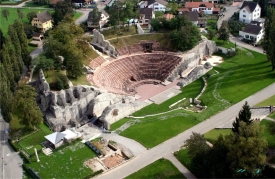
Its scale is striking even before visitors consider the political message carried by its decoration. The official monument account estimates that the seating area, or cavea, accommodated about 7,000 spectators. The theatre occupied one of the city’s higher hills, allowing builders to cut the central seating into bedrock and support the flanks with vaulted galleries. The stage front and surviving architectural pieces help visitors imagine the building without disguising what is reconstructed.
The theatre was designed for performance, but also served civic life in a Roman colony. The inscriptions over two side entrances honoured Lucius Caesar and probably Gaius Caesar. The museum interprets these dedications within the political and religious programme of the Augustan age: public buildings could connect entertainment with imperial authority. That context adds meaning to the stones, while the careful wording of the evidence keeps probable identifications distinct from certainty.
How the monument disappeared and returned
Unlike many ancient theatres known through written descriptions, Cartagena’s was not continuously recognized as a Roman monument. Successive neighbourhoods occupied the site, and later construction hid the original shape. The old church partly overlies the upper theatre; this visible overlap is one reason the visit reads like an archaeological cross-section rather than a walk around a freestanding classical shell.
Modern excavation began in October 1988, during an initial campaign in the plot of the Casa-Palacio de la Condesa Peralta. Archaeologists found a complex sequence of structures and architectural fragments. In 1990, the remains could be identified, though only partially, as a Roman theatre. The discovery changed plans for the site and opened a long process of research, conservation and public interpretation.
A 1996 agreement involving the regional government, Cartagena City Council and Fundación Cajamurcia gave the recovery project a more structured framework. The museum reports that the nearly complete excavation of the theatre took place between 1996 and 2003. Work exposed not only the seating and stage area, but also evidence of the urban layers that had accumulated above and around the ancient building.
The institution’s timeline records the museum’s inauguration on 11 July 2008. Architect Rafael Moneo designed a route that begins near the Town Hall Square, incorporates the historic Pascual de Riquelme Palace and passes through underground exhibition spaces and an archaeological corridor beneath Santa María la Vieja. The final reveal is the theatre itself. Rather than treating the museum as a separate preface, the route makes the process of concealment and discovery part of the experience.
Reading the architecture and the city
Inside the theatre, look first at the relationship between the hillside and the seating. The central cavea was cut into the rock, while vaulted structures supported the side sections. Horizontal divisions and radial stairways organized circulation and viewing. These practical choices also reflected Roman social distinctions: inscriptions and the arrangement of the orchestra show how access and places of honour were assigned, although not every visitor’s exact seat can be reconstructed.
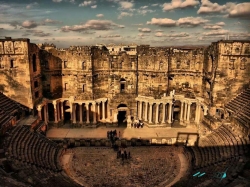
The orchestra formed a semicircle in front of the stage, with reserved seats for authorities. The proscenium measured 43.60 metres, according to the museum’s architectural description. Behind the stage stood an elaborate scenic façade, reconstructed through the study of architectural traces and surviving pieces. The display uses original fragments alongside interpretation, so visitors should distinguish preserved material from the museum’s architectural explanation of the building’s former appearance.
Finds from excavation help explain how decoration worked as a public language. The museum highlights capitals, bases, columns and altars associated with the theatre, including imagery linked to the Capitoline Triad. Its account describes materials such as Carrara marble and pink travertine, alongside local sandstone. The contrast of stone colours and the scale of the stage architecture suggest a carefully composed monument, not merely a practical seating bowl.
The surrounding site also records later lives of the hill. Museum interpretation describes the theatre’s decline and the reuse of its remains, including a later market and successive urban occupations. Medieval walls and a Roman house with a mosaic are visible along the archaeological corridor. These remains are not decorative extras: they show how Cartagena repeatedly adapted the same terrain, leaving a layered record that can be read during the museum visit.
Planning a thoughtful visit
The museum is at Plaza del Ayuntamiento, 9, in central Cartagena, Murcia. Its official schedule lists winter hours from Tuesday to Saturday, 10:00 to 18:00, and summer hours from Tuesday to Saturday, 10:00 to 20:00; Sundays are listed as 10:00 to 14:00, while Mondays are closed. Seasonal dates and holiday exceptions apply, and the operator warns that hours may change, so check its current visitor page before setting out.
At the time of the official listing consulted, general admission was €7 and reduced admission €6, with free-entry categories and a Tuesday late-opening free period subject to conditions. The museum says guided visits last about an hour; tours are in Spanish, and availability in another language should be confirmed by telephone. These prices and arrangements are not permanent guarantees. Confirm the live ticket page, reservation requirements and any temporary access notices for your travel date.
Allow time for the whole route rather than only the theatre. The museum’s sequence explains the excavation, presents architectural finds, passes beneath the medieval church and ends at the seating area. Lifts and escalators are listed among its accessibility provisions, as are a loan wheelchair and adapted toilets; nevertheless, visitors with specific mobility needs should contact the museum to confirm which route and facilities are available on the day. The monument rewards a slower visit: what looks like one ancient building is also a record of how Cartagena was built over it, uncovered it and chose to preserve it.