Olympiastadion Berlin: 1936 history, architecture and visitor guide
The Olympiastadion Berlin is both a working sports venue and a monument whose architecture carries a complicated history. Built for the 1936 Olympic Games under the Nazi regime, it became part of a carefully staged political spectacle; the same arena is now used for football, athletics, concerts and guided visits. Its scale is striking, but the experience is richer when visitors understand what the stadium was designed to communicate, how it was altered after the war and what can actually be seen on a non-event day. Plan around the live calendar: the public programme can close or restrict areas when the stadium hosts an event.
A monumental arena and the 1936 Games
The present stadium was built between 1934 and 1936 as the centrepiece of Berlin’s Olympic grounds. Berlin’s official heritage database dates the structure to those years and identifies Werner March as its architect; the venue’s own chronology explains that the Nazi government expanded and redirected the project after Adolf Hitler became chancellor in 1933. The resulting complex was not simply a sports building. Its monumental layout and ceremonial spaces were designed to make the regime’s power visible during an international event.
The Olympic Games opened at the stadium on 1 August 1936 and closed on 16 August. The venue’s historical record counts 3,956 athletes from 49 nations. American athlete Jesse Owens became the most successful competitor of the Games, winning four gold medals in the 100 metres, 200 metres, long jump and 4×100-metre relay. His victories took place inside a spectacle organized by a racist dictatorship, a contrast that remains central to interpreting the stadium. Visitors should not separate the architectural grandeur from the political purpose for which the grounds were staged.
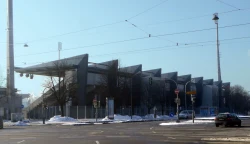
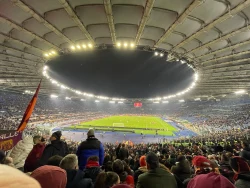
One detail visible in the stadium’s design is the relationship between the arena and its setting: the roof leaves a deliberate opening toward the Marathon Gate, the Maifeld and the Bell Tower. The venue’s history says heritage authorities required those views to remain unobstructed during the later renovation. The result is a roof that appears to float above the stands, supported by slender steel columns. Looking through the opening helps visitors read the arena as part of a larger Olympic landscape rather than as a sealed bowl.
From post-war stadium to modern venue
After the war, the site passed into public ownership and the stadium’s role changed. It became Hertha BSC’s home in 1963 and continued to host major football and athletics events. The State of Berlin voted in 1998 to renovate and modernize the listed structure in line with heritage-conservation guidelines. Work began in 2000; the stadium operator reports a project cost of about €240 million. The renovation rebuilt much of the lower seating ring while preserving important historic elements, including the open sightline at the Marathon Gate.
The stadium reopened in summer 2004 and later hosted the 2006 FIFA World Cup final between Italy and France. It has since staged the 2009 World Athletics Championships, the 2011 FIFA Women’s World Cup final, the 2015 UEFA Champions League final and the UEFA EURO 2024 final. The operator’s current fact sheet lists 73,877 seats. That figure describes the seated stadium configuration; event layouts and standing concerts can differ. The venue remains a working arena rather than a preserved shell, so sporting and cultural events continue to shape both its use and visitor access.
The protected monument’s architecture is therefore not frozen in time. A modern roof, rebuilt seating and contemporary visitor facilities coexist with the historic stone exterior and ceremonial geometry. The operator’s chronology and Berlin’s heritage register provide different but complementary perspectives: one traces how the venue works today, while the other records why its 1930s design is protected. A visit becomes more meaningful when both are kept in view.
What visitors can see and how tours work
On a regular sightseeing visit without a guide, visitors can access public exterior areas and the grandstands; the official FAQ says restricted spaces such as players’ changing rooms and VIP areas require a guide. A multimedia guide uses GPS navigation to lead visitors through the stadium and Olympic Park, and the operator estimates 75 to 100 minutes for the route. The device is offered in German, English, Spanish, French and Italian. The FAQ recommends allowing one to two hours overall, which leaves time to pause at the grounds and interpret the architecture.
For behind-the-scenes access, the operator offers scheduled guided tours, including a 60-minute highlight tour that can enter areas normally closed to the public. Tour itineraries may include VIP spaces, changing rooms and the underground warm-up hall, subject to availability and event restrictions. Public-tour tickets are recommended in advance; the FAQ says they are generally bookable around four to six weeks beforehand, while private tours may be arranged six to eight weeks ahead. Group sizes are limited, and accessible arrangements for restricted areas should be discussed with the venue before booking.
The current sightseeing page lists admission at €11 for adults, €8 at the reduced rate, €6 for children aged 6–14, and €27 for a family card covering two adults and up to three children. The multimedia guide costs an additional €4. Prices and products can change, so confirm them on the official ticket page. Visitors may take photographs for private use, but tripods and filming during tours are not permitted. Dogs are not allowed, and visitors may not walk on the pitch or the blue track. There is no luggage storage service.
Opening times, transport and a thoughtful visit
Opening hours are not fixed throughout the year. The official site publishes a live schedule and warns that it can change at short notice; last entry is up to 30 minutes before closing. The stadium and visitor centre close on event days, including Hertha BSC home matches and major events, and preparations can restrict parts of the grounds even before an event. Check the calendar shortly before travelling rather than relying on a search snippet or an older printed timetable. A ticket for a self-guided visit does not guarantee access to every area.
Public transport is straightforward. The stadium’s FAQ gives the S-Bahn lines S3 and S9 to Olympiastadion station, about a four-minute walk from the visitor centre, or the U-Bahn U2 to Olympiastadion station, about seven minutes away. Bus options include M49 at Flatowallee and route 104 at Neu-Westend, followed by walks of roughly ten and fourteen minutes. Check Berlin’s live transit information for service changes on the day, especially around match and concert traffic.
Give yourself time to read the place, not only photograph the stands. The visitor programme opens a route through a major sports venue, but its history demands attention to both athletic achievement and the propaganda setting of 1936. The arena’s later use by Hertha BSC and its international events shows how public meaning can change without erasing the past. With the event calendar checked, the right ticket selected and one or two hours set aside, the Olympiastadion offers a distinctive encounter with Berlin’s sporting, architectural and political history.