About Juliaca
A highland city with its own story
Juliaca is the capital of San Román Province in Peru’s Puno Region, a commercial and transport center on the Collao Plateau. The national tourism inventory places the Santa Catalina church at about 3,828 metres above sea level; the exact elevation varies by point across the city, so this is best read as a high-altitude destination rather than a single precise figure. Travelers often pass through on their way to Puno and Lake Titicaca, but Juliaca rewards a stop of its own: its railway history, busy central streets, religious architecture and large annual Carnival reveal a different side of the southern Andes.
The city lies roughly 45 kilometres from Puno by road. Peru’s official tourism service describes the journey from Juliaca to Puno as about 45 minutes by bus or car, although traffic and weather can change the trip. Juliaca also has Inca Manco Cápac International Airport, around five kilometres from the city center, making it an important arrival point for the region. Airport information lists flight status, authorized taxis, parking and local shops; flight schedules and transport availability should be checked close to travel, not inferred from old guidebooks.
Railway tracks that changed the town
Juliaca’s modern growth is closely linked to the arrival of rail. The provincial municipality identifies 1873 as the year the railway reached Juliaca and describes it as a turning point: the settlement developed around its station and strengthened its role as a commercial and road junction in Puno. The train did more than shorten a journey; it connected a highland market town to wider routes and helps explain why Juliaca became a place where regional products, travelers and businesses meet. A municipal history also links the completion of the Arequipa–Puno railway to the city’s increasingly modern and commercial profile.
The political map followed that economic change. San Román Province was created in 1926, with Juliaca as its capital. The city’s identity today is therefore not only administrative; it is also shaped by movement and exchange. Markets and transport corridors remain part of everyday life, while the airport and road links connect the city with Puno and other destinations in southern Peru. Visitors should expect an active working city, not a polished resort district: the most useful way to experience it is to pair a walk through the center with time for its historic buildings, food and public celebrations.
Santa Catalina and the historic center
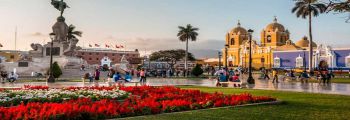
Templo Matriz de Santa Catalina stands on the east side of Juliaca’s Plaza de Armas, a short walk from the central square. Peru’s Ministry of Foreign Trade and Tourism inventory says construction began in 1649 under the Jesuits and was completed in 1774, after 125 years of work interrupted by financial and labor difficulties and the Jesuits’ expulsion in 1767. The same inventory records the church as a historic monument and identifies it as a colonial-era landmark. Its long construction history is a useful counterpoint to the city’s rapid railway-era growth.
The tourism inventory lists free entry and describes access around services, with hours of 7:30–10:00 a.m. and 5:30–7:00 p.m. daily and Sunday access throughout the day. These are not a guarantee of current visitor hours: a church may close or change access for worship, maintenance or local events. Check locally before planning an interior visit, and approach services respectfully. Around the plaza, the value of the historic center is as much in its everyday rhythm as in any single monument: residents use it as a civic meeting point, while the surrounding streets connect shops, markets and religious sites.
Carnival, faith and the calendar
Juliaca’s Carnival is one of the region’s defining public celebrations, traditionally held during the season between January and March. Dancers and musical groups fill the streets with elaborate costumes, choreographed processions and forms associated with the Altiplano. The exact program, dates and parade routes vary by year, so travelers should look for announcements from the municipality rather than rely on a past festival schedule. In 2025, Peru’s Law No. 32363 declared the Juliaca Carnival to be of national interest, recognizing its cultural significance; that wording should not be confused with a claim that it has already received a separate heritage inscription.
Religious observances also shape the year. The local tourism inventory notes the Feast of the Cross in May, San Juan in June, All Saints’ Day in November and Christmas in December, alongside Holy Week, whose dates move each year. These occasions give visitors a chance to see how public space, faith and regional identity intersect, but they also bring crowds and temporary changes to traffic. If a festival is the reason for a trip, confirm dates and access with local organizers before booking transport or lodging.
Using Juliaca as a base for Puno and Sillustani
Juliaca is practical for travelers combining several destinations in Puno Region. Peru Travel places the drive to Puno at roughly 45 minutes and describes Sillustani as lying along the route between the two cities. The archaeological complex is a Colla funerary landscape beside Lake Umayo, with tall stone burial towers and a site museum. The official tourism page currently lists visiting hours of 8:30 a.m.–5:30 p.m. daily and a general ticket of S/17, but fees and opening arrangements can change; reconfirm before setting out. The route makes it possible to connect the airport, Juliaca, Sillustani and Puno in a regional itinerary, though each deserves enough time rather than being treated as a quick photo stop.
For a straightforward city visit, begin at the Plaza de Armas and Santa Catalina, then leave time to observe the markets and the commercial streets that explain Juliaca’s reputation as a regional hub. The airport operator also describes the city as a starting point for Lake Titicaca-area excursions and provides information on taxis and parking. Ask about the final fare and destination before boarding a taxi, and allow a margin for road travel. Current flight schedules, church access and festival dates are the details most likely to change; official municipal, tourism and airport notices are more dependable than undated snippets copied between travel sites.
A stop that makes the region legible
Juliaca is easy to underestimate when it appears only as an airport code or a transfer between Lima, Puno and the lake. Its story is more substantial: a high plateau settlement reshaped by the railway, a provincial capital since 1926, a commercial crossroads and a host to a Carnival that Peru has formally recognized as nationally significant. Santa Catalina’s 125-year building history adds a quieter architectural layer, while nearby Sillustani offers a clear extension into the region’s pre-Hispanic past.
Plan around the city’s real strengths rather than expecting a resort-style attraction with a single ticket desk. Use Juliaca as a place to understand how people, goods and traditions move across the Altiplano; check practical details close to departure; and allow time for both the central square and the road beyond it. The best visit links the city’s living streets to the wider Puno landscape, where the journey between Juliaca, Sillustani and Lake Titicaca is part of the experience, not merely the distance between landmarks.