Donbass Arena: Shakhtar’s stadium, Euro 2012 and a home lost to war
A stadium whose story cannot be a travel invitation
Donbass Arena belongs to Donetsk, Ukraine, and to a football history interrupted by war. This is not a destination for a present-day stadium excursion. The British FCDO's advice, updated on 2 October 2026 and checked on 29 October, advises against all travel to Donetsk. The arena's significance can be explored through its sporting and architectural record without treating historic visitor information as evidence of safe access today.
The stadium's ceremonial opening took place on 29 August 2009. Shakhtar then played their first match there on 27 September, defeating Obolon 4–0, with Jadson scoring the first goal. Those are different milestones: the public celebration introduced a new landmark, while the first competitive home appearance began the footballing life that supporters would attach to it.
For Shakhtar, the ground offered a large, purpose-built home at a moment of international ambition. Its story is inseparable from the club, but the project also placed Donetsk before a wider audience. The importance of the stadium was never simply a number of seats. It was a place where a team, its supporters and a city's public image could meet.
Architecture for football and a European tournament
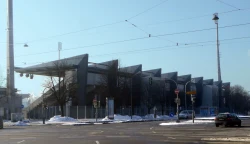
Designed by Arup Sport and built by principal contractor ENKA, the arena took an oval form behind a glazed exterior. Its inclined roof gave the structure a distinctive profile. The contractor describes translucent roof sections intended to admit daylight for the natural grass, alongside ventilation openings around the lower concourse. These details show a building shaped by the practical demands of a living playing surface as well as spectacle.
The wider project included a landscaped park and spaces for more than the ninety minutes on the pitch. The club's historical infrastructure account describes a museum and a Walk of Fame honouring figures associated with Shakhtar. These were parts of a broader public experience around the ground. Their inclusion in an archive describes the arena's earlier life; it does not establish that those facilities are operating now.
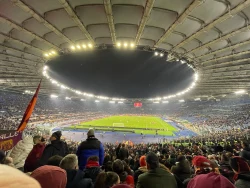
Euro 2012 gave the venue its largest international stage. It hosted five matches, including three group games, a quarter-final and a semi-final. On 27 June, Spain and Portugal finished goalless before Spain won the shoot-out 4–2. UEFA's contemporary reporting described supporters gathering in Donetsk from several countries, recording a period when the city's name travelled with a shared European football festival.
From home matches to humanitarian work
Shakhtar's own retrospective identifies 2 May 2014 as their last home match at Donbass Arena: a 3–1 victory over Illichivets. The sporting detail makes the interruption tangible. A fixture that belonged to a familiar domestic calendar became a boundary in the club's history. Supporters could later look back to an ordinary match day that had acquired a meaning nobody could reduce to the score.
The conflict forced Shakhtar away from Donetsk. In a Ukrainian-language interview published on 1 June 2026, club president Rinat Akhmetov recalled having to leave their homes when occupation began in 2014. His account places the stadium inside a larger experience of displacement. The loss was not only a venue in which to stage matches, but the separation of a club community from its accustomed place.
The building also took on a humanitarian role. The club's 2016 anniversary account records that a help headquarters was established at the arena in August 2014, using it as a logistics centre for unloading and distributing food. That is a documented historical use, not an assertion that the same operation continues today. The change from crowds arriving for football to aid distribution marks another chapter in the arena's interrupted life.
Memory, condition and an uncertain future
Current descriptions require care. In the June 2026 interview, Akhmetov said the stadium appeared to be in poor condition. That is an attributed assessment by the club president, not an independent engineering inspection of the building. Historic photographs, old hospitality pages or architectural specifications cannot establish the present condition of the roof, stands, pitch or public facilities.
The club's annual-report announcement of 11 October 2026 again recalled the opening and the attachment of supporters to the arena. Such memories explain why a stadium remains central to a club that has been forced away from it. They should not be mistaken for a reopening announcement. No confirmed timetable for a return, restoration or public stadium tours is established by those accounts.
For now, the useful route into Donbass Arena is through records: match reports, the architect and contractor's project history, and the club's documented memories. Its future depends on circumstances far beyond football scheduling. The contrast remains stark: a stadium built for international gatherings, remembered through celebrated games and community life, in a region where the dated official warning rules out recommending a tourist journey.