About Cochem Castle
Few sights along Germany's Mosel River are as instantly captivating as the silhouette of Reichsburg Cochem rising more than a hundred metres above the water on its conical hilltop. With pointed turrets, slate-grey roofs, and curtain walls that seem to grow organically from the cliff face, the castle resembles something dreamed up by a fairy-tale illustrator rather than a real fortress. Yet Reichsburg Cochem is very real, and its thousand-year history embraces medieval emperors, French invasions, a Romantic-era reinvention, and one of Germany's most picturesque modern attractions.
The castle dominates the small wine town of Cochem in the Rhineland-Palatinate region, an hour's drive west of Koblenz. Together with the surrounding vineyards that climb the surrounding slopes, it forms a landscape so quintessentially German that travellers often pause on the riverbank simply to confirm it is not a film set.
Imperial Origins
The earliest documented mention of Cochem Castle dates to 1130, although archaeological evidence suggests fortifications may have stood here as early as the year 1000. The first known proprietor was the Palatine Count Ezzo of Erenfriede, whose family dominated parts of the Rhineland during the late Ottonian and early Salian periods. Romanesque foundations and a square keep with walls up to three and a half metres thick survive from this earliest phase.
The castle's status changed dramatically in 1151, when King Conrad III of the Hohenstaufen dynasty wrested it from feuding palatinate counts and declared it an imperial castle, a Reichsburg, the term that still appears in its name today. As an imperial possession, the fortress took on the role of administering tolls along the Mosel, a vital economic corridor between France and the Rhine, and collecting customs from the heavily laden barges that plied its waters.
The Archbishops of Trier
In 1294, King Adolf of Nassau pawned Cochem Castle along with its surrounding villages to Archbishop Bohemund I of Trier in order to finance his coronation as German emperor. Neither Adolf nor his successor, Albert I of Habsburg, ever managed to redeem the pledge, and so Cochem became a hereditary fief of the Archbishopric of Trier, remaining under ecclesiastical authority for nearly five centuries until the secular reorganization of 1794.
The fourteenth century saw substantial expansion under Archbishop Baldwin of Luxembourg, an exceptionally energetic prince-elector who connected the castle to the town below with massive defensive walls and stretched a great chain across the Mosel that could be raised from the castle to halt river traffic, thereby enforcing customs collection.
Destruction in the Nine Years' War
The most violent chapter in the castle's history unfolded in 1688 and 1689 during the Nine Years' War, also known as the War of the Palatine Succession. As the armies of Louis XIV swept down the Rhine and Mosel valleys, executing a deliberate scorched-earth strategy designed to reduce the western German states to ruin, Cochem Castle could not withstand the assault. French troops captured the town in March 1689, set the castle ablaze, and on May 19 of that year detonated explosives that reduced its proud walls to rubble.
For the next 180 years, the ruins of Reichsburg Cochem stood as a melancholy backdrop to the wine harvests of the valley, slowly succumbing to weather and to scavengers who carried off cut stones for their own buildings.
The Romantic Reinvention
Salvation arrived in 1868, when a Berlin businessman named Louis Ravené purchased the ruined complex for the modest sum of three hundred gold marks. Ravené, a successful industrialist whose family had originally fled Catholic France as Huguenot refugees, was deeply connected to the construction of the strategically important Koblenz-Metz railway and saw in Cochem the perfect summer residence for his family. Across the next decade, working with the architects Hermann Ende and Julius Carl Raschdorff, Ravené rebuilt the castle in a fanciful Neo-Gothic style that blended scholarly medievalism with the Romantic ideals then sweeping nineteenth-century Germany.
The reconstruction, inaugurated in 1877, gave the castle the silhouette familiar to visitors today: pointed dormers, decorative crenellations, and a tall central keep crowned by a slender spire. The interiors were furnished with carefully collected Renaissance and Baroque pieces, many of which remain in place. The dedication of the rebuilt castle even left its mark on German literature: a scandalous adultery involving Ravené's young wife inspired Theodor Fontane's first Berlin society novel, L'Adultera.
Inside the Castle Today
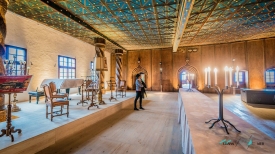
Since 1978, Reichsburg Cochem has belonged to the town of Cochem itself, administered by a public company that opens the building to visitors throughout most of the year. Guided tours, available in several languages, lead through a remarkable suite of rooms that includes the Knights' Hall, used for ceremonial banquets; the Hunting Room, lined with antlers and flintlock weapons; the Trophy Room; the bower or ladies' chamber; and a romantic dining hall where the Ravené family once entertained Berlin society on summer evenings.
For those who want to inhabit the experience more fully, the castle hosts elaborate medieval-style banquets known as Knights' Feasts on selected Friday and Saturday evenings, complete with costumed servants, troubadours, mead, Mosel wine, and a mock knighting ceremony at the end of the night. An annual castle festival in the first week of August fills the courtyards with artisans, jugglers, and folk musicians, and a winter Castle Christmas reimagines the nativity story across the gardens and alcoves of the upper terraces.
The Wider Mosel Experience
A visit to Cochem Castle pairs naturally with a tour of the surrounding wine country. The dark slate slopes that frame the Mosel produce the elegant, mineral-driven Rieslings for which the region is celebrated, and family-run wineries throughout Cochem and the neighbouring villages welcome visitors for tastings. River cruises operated by KD Cruises connect Cochem to Koblenz, Trier, and other charming towns along the valley, offering a leisurely complement to the climb up to the castle.
The walk from the town centre to the castle gates rises sharply but rewards visitors with steadily expanding views; alternatively, a shuttle bus service runs throughout the day for those who prefer to save their energy for the tour itself. Pinnerkreuz, a lookout reached by chairlift across town, offers the finest panorama of the castle in its full hilltop glory.
For travellers in search of a destination where Mosel wine, medieval romance, and nineteenth-century imagination meet on a single hilltop, Reichsburg Cochem stands among the most rewarding stops in western Germany.