About Historic Town of Ouro Preto
A historic town written into a mountainside
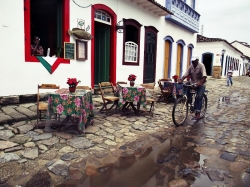
Ouro Preto rises over steep slopes in Minas Gerais, where narrow, winding streets connect churches, squares, fountains and residential buildings across an irregular landscape. The town’s name means “Black Gold,” recalling the mineral wealth that made Vila Rica—the settlement’s earlier name—a centre of Brazil’s eighteenth-century gold rush. Rather than a planned grid, the historic core follows the contours of the hills. Its topography shaped the routes, views and architecture of the town.
UNESCO inscribed the Historic Town of Ouro Preto on the World Heritage List in 1980, Brazil’s first cultural property on the list. The protected area includes a closely connected group of public buildings, houses, bridges, fountains and religious monuments. UNESCO emphasizes both the town’s artistic achievements and its relationship with a rugged setting. The distinction matters for visitors: the heritage is not confined to one church or museum, but lies in the way individual landmarks fit into a street plan that grew around mining, government, worship and everyday life.
Gold wealth, colonial power and a changing city
Founded at the end of the seventeenth century and developed in the following decades, Ouro Preto became the focal point of gold extraction in the region. Its prosperity connected the interior of Portuguese America to imperial administration and trade. The town was known as Vila Rica and served as the capital of Minas Gerais from 1720 to 1897. The wealth visible in churches and civic buildings came from a colonial mining economy; the polished heritage landscape should not obscure the hard labor and unequal power that supported it.
Mining declined as deposits were exhausted during the nineteenth century, and the city’s political and economic influence diminished. That decline helped preserve much of the colonial urban pattern, though it did not freeze Ouro Preto in time. Houses, streets and institutions continued to change, and conservation remains an active responsibility. UNESCO notes pressures that include urban growth, traffic and development on surrounding slopes. Residents, students, businesses and visitors share streets whose scale and steepness were set long before modern transport.
Baroque art in churches and public spaces
The churches are among the most visible expressions of Ouro Preto’s eighteenth-century prosperity and artistic life. The municipal tourism office describes the Church of São Francisco de Assis as a major work associated with Antônio Francisco Lisboa, known as Aleijadinho. Its Third Order began planning its own church in the mid-eighteenth century; construction started in 1765 and was largely complete by 1771. The city account highlights the curved lines of the nave and façade as distinctive features. The church is more than an isolated monument: its position on the slope connects it to lanes, neighbourhoods and views across the historic centre.
Other landmarks, including the churches of Nossa Senhora do Pilar and Nossa Senhora do Carmo, help explain the density and variety of sacred art in the town. UNESCO points to the work of Aleijadinho and painter Manuel da Costa Athaide, as well as the use of local stone such as soapstone in architectural decoration. Praça Tiradentes, the central civic square, brings together public memory and urban life. Look closely at façades, fountains and changes in street level; the town’s character is as much in these transitions as in the interiors of its best-known churches.
Inconfidência history and museums
Ouro Preto is also associated with the Inconfidência Mineira of 1789, a movement against Portuguese colonial rule that became an important symbol in Brazil’s history of independence. UNESCO calls the town its symbolic centre. The story is not reducible to a single heroic figure or a finished national narrative: it belongs to a colonial society shaped by mining, taxation, political ambitions and unequal status. The former administrative and prison building on Praça Tiradentes now houses the Museu da Inconfidência, linking the setting of public authority to a museum devoted to the episode and its historical memory.
The municipality announced that the Museu da Inconfidência reopened on 30 August 2025 after improvement works, with free admission. Its dedicated reopening notice lists visits Tuesday through Thursday from 10 a.m. to 6 p.m., Friday and Saturday from 10 a.m. to 8 p.m., and Sunday from 10 a.m. to 6 p.m.; last access is one hour before closing. Because this schedule comes from a dated reopening announcement, check the museum or municipal tourism office before travel for later changes, temporary closures or special programming. The municipal tourist map is also useful for locating the museum among nearby churches and other attractions.
Planning a walk and making time for the hills
Ouro Preto rewards slow exploration, but the steep streets call for realistic pacing and comfortable shoes. The municipal tourism office lists the Church of São Francisco de Assis as open Tuesday through Sunday, 8:30 a.m. to 5 p.m., and closed Monday; it advises visitors to call for the current entrance fee. These are the hours shown on the official listing checked for this guide and should be confirmed shortly before a visit. The same office describes the Santa Efigênia viewpoint as free and open around the clock, reached by a steep climb of about 500 metres from the Antônio Dias bridge.
Use the municipal tourist map to build a route around the historic centre, then leave room for pauses: a square, a church exterior, a museum or a viewpoint can each take longer than expected. The map also identifies districts beyond the central seat, so a longer stay can extend beyond the most familiar streets. Opening hours vary by institution and may change for holidays or restoration work; a landmark’s exterior can remain visible even when its interior is closed. Check official notices rather than relying on an old itinerary, especially for museums, mine visits and transport between Ouro Preto and nearby towns.
How to read Ouro Preto today
The town’s UNESCO status is not a promise that every building is perfectly preserved. UNESCO recognizes its outstanding urban and artistic character while noting pressures such as traffic, new construction and vulnerable slopes. Visitors can help by keeping to public routes, following guidance inside churches and museums, and treating residential streets as neighbourhoods rather than scenery. Photography rules vary, so ask before taking pictures. Small details can be revealing: a fountain built into a slope, a change in paving, or a church tower at the end of a narrow street.
Ouro Preto is compelling because its beauty carries a complicated history. Gold financed religious art and civic architecture, but it also tied the town to colonial extraction; the Inconfidência’s memory adds another layer of political change. A thoughtful visit holds these stories together instead of reducing the town to a picturesque backdrop or a list of famous interiors. Begin with the street plan, choose a few sites whose current access you have confirmed, and give yourself time to climb, stop and look. The enduring impression is of a city whose architecture and landscape still ask how wealth, power, creativity and memory shaped one another.