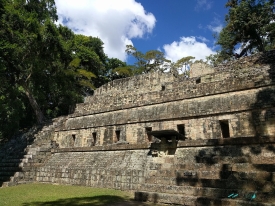
San Andrés is one of the best places in El Salvador to see how a Maya political and ceremonial centre organised space. Set in the fertile Zapotitán Valley in La Libertad, the park combines broad plazas, earthen architecture, a site museum and evidence from a much later colonial indigo operation. The visible monuments are less vertically dramatic than the stone pyramids of some Maya cities, but their scale and construction reveal a regional centre with authority over surrounding communities during the Classic period.
The settlement’s strongest phase is generally dated between about AD 600 and 900, after volcanic disruption had reshaped life in the valley. Its elevated Acropolis supported Structures 1 through 4, constructed largely with adobe and other earthen materials. To the north, a large plaza is framed by buildings that include the site’s tallest, bell-shaped structure. Structure 7 differs in form and construction from the main monumental group, one reason archaeologists examine San Andrés not as an isolated city but as part of wider networks across Mesoamerica.