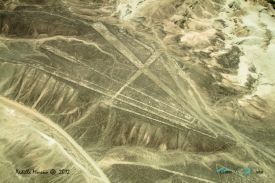
The aqueducts of Nasca are works of hydraulic engineering that we should reevaluate and seek to consider as a marvel of civil engineering, equal to the sanctuary of Tipón in Cusco. These aqueducts lead the filtration of the Aija, Tierras Blancas, and Nazca through underground stretches and open uncovered stretches. In the covered sections they built funnels in helical sections every certain distance (50, 100, 120 m.), with the end purpose of carrying out maintenance of the ditches and bear atmospheric pressure to water and maintain a uniform flow rate, also preventing erosion or sedimentation in the channel. The funnels have an average length of approximately 70 to 80 steps (about 49 meters) where one can enter relatively easily to take care of maintenance. The walls of the funnels are lined with cobble stones, apparently placed without agglomerate, and they maintain their stability in spite of the natural phenomenon that have occurred (last earthquake in Nasca 1996).
In the covered sections of the canal, for the roof they used finely placed stone slabs and slots from Huarango trees. The construction of these covered canals makes one think that they knew the techniques of subterraneous topography. How did they manage to follow a suitable direction with an optimal slope that maintained the necessary uniform flow, with the end guarantee of the durability of the structure?