Munich Airport: Travel Guide, Connections and Visitor Park
Munich Airport is both a working international gateway and a place where the scale of modern air travel is unusually visible. Officially named Munich Airport, it serves Bavaria from Erdinger Moos, about 28.5 kilometres from central Munich. Most travelers arrive to change planes or begin a trip, not to sightsee, yet the site has a public visitor park and observation hill that can turn an airport stop into a short aviation outing. The useful distinction is between the secure passenger terminals and these landside public areas: they serve different purposes and have different access rules.
From Riem to a new airport in one night
The present airport began operating on 17 May 1992, after Munich’s former airport at Riem closed. The airport’s own history describes an extraordinary transfer carried out between 16 and 17 May: about 5,000 people and roughly 700 trucks moved the operation to Erdinger Moos in around 16 hours, with flights continuing until the changeover. That logistical feat explains why the airport’s origin story is more than a construction date. It was a coordinated relocation of an active transport system, from an urban site toward a purpose-built regional hub.
The airport is named for Franz Josef Strauss, the former Bavarian minister-president. Today its infrastructure includes two passenger terminals and a midfield satellite connected to Terminal 2. In April 2026, a new pier at Terminal 1 entered service as a central access and departure point for that terminal’s non-Schengen traffic. Travelers should still check their airline and boarding pass rather than infer a terminal from destination alone: terminal assignments and gate information are operational details that can change.
Recent traffic figures help put the scale in perspective. Munich Airport’s preliminary annual figures record 43.4 million passengers in 2025, 4.4 percent more than in 2024, and about 337,450 aircraft movements. These are airport-wide annual totals, not a forecast of how busy a particular day or security queue will be. The same report describes a broad international route network and growth in European and long-haul traffic. For a traveler, the practical point is simple: leave time for the connection, verify the live flight information and use the airport’s current guidance rather than an old itinerary or third-party page.
Terminal 2 and its satellite are part of a joint operating structure with Lufthansa and are used by Lufthansa Group and Star Alliance airlines, according to the airport’s current corporate information. The satellite’s underground passenger transport system links it to the main Terminal 2 building. Terminal 1 has its own check-in and pier arrangements, now including the 2026 expansion. If you are meeting someone, allow time to identify the correct arrivals area; “Munich Airport” covers a large campus, not one compact concourse.
A public aviation visit beyond the terminals
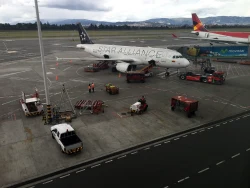
The Visitors Park is the airport’s dedicated public-facing attraction. The airport describes the outdoor park as accessible free of charge throughout the year and all day. Its 28-metre observation hill offers a view of aircraft on the apron and runways; admission to the hill is listed at €1. The hill is reached from the public side of the airport, so visitors do not need a boarding pass to use the park, but this is not permission to enter secure terminal or airfield zones.
The interactive exhibition at the visitor information centre presents airport operations, aircraft, staff, equipment and processes. As checked on 3 October 2026, the German airport page lists it daily from 9:00 a.m. to 5:00 p.m. with free entry. The outdoor playground is also listed as free. These separate attractions do not all share the same access conditions: the observation hill is open all day, while the exhibition has stated hours and can close for maintenance or special dates. Check the live page before building an outing around a particular exhibit.
Aircraft enthusiasts should pay special attention to the airport’s current maintenance notice. The display of historic aircraft—including the Super Constellation, Douglas DC-3 and Junkers Ju 52—is described as closed for renovation until further notice. The airport’s page still provides background on the aircraft, but that is not confirmation that visitors can currently enter them. By contrast, the observation hill and general park remain listed separately. This is a good example of why “the visitor park is open” does not automatically mean every exhibit or aircraft can be visited.
Airport tours are also promoted by the operator for close-up views of aviation activity, but tour availability, language, route, security requirements and booking slots depend on the programme. Check the airport’s own visitor information before traveling for a tour. The open visitor park is a more flexible option for families or people with a few spare hours; bring weather-appropriate clothing, since the main experience is outdoors and the hill is exposed. The airport notes that access to the hill is not suitable for strollers or wheelchairs.
Getting between the airport and Munich
The S-Bahn is the most direct rail link to the city. Lines S1 and S8 alternate between the airport and Munich, with the airport estimating roughly 40 minutes to the central railway station and a combined interval of about ten minutes under normal operation. S1 runs via the western side of the city; S8 via the east and Ostbahnhof. Their operating intervals differ overnight, so do not treat the ten-minute daytime rhythm as a guarantee at every hour.
There are two S-Bahn stations within the airport area. “Flughafen München” serves Terminals 1 and 2; “Besucherpark” is useful for the visitor park and some administrative or cargo-area destinations. The station that is right for you depends on whether you are catching a flight, meeting a passenger or visiting the exhibition. Follow airport signs and check the route planner for the exact station and platform before boarding.
For anyone arriving by car, the airport’s landside visitor facilities and passenger parking are separate from restricted airside areas. The terminal campus is large, and walking times between points matter, particularly if you have luggage or a tight connection. Confirm your airline’s terminal, check-in information and current security guidance before departure. If you plan a visitor-park stop, make sure the schedule leaves enough time to return to the correct terminal and pass normal airport procedures.
Munich Airport can be approached in two ways: as a transit hub to navigate efficiently, or as a working landscape to observe from its public visitor areas. The first calls for live flight and rail checks; the second rewards a clear look at opening times and maintenance notices. A short visit to the hill or exhibition can add context to a journey, while the airport’s 1992 relocation and continuing expansion explain how this site became one of Bavaria’s major gateways. Treat schedules and access as changeable, and the place becomes easier to appreciate without confusing public attractions with the passenger operation.