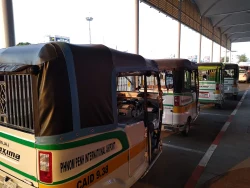
Former Siem Reap airport: the old gateway to Angkor after the move to SAI
A familiar airport name, a different destination
The former Siem Reap International Airport belongs to the travel history of Angkor, rather than to today’s flight itinerary. Its old code, REP, still appears in photographs, earlier guidebooks and archived descriptions of Cambodia’s tourism industry. The name can be misleading when it survives on a map: the replacement airport is a separate facility, with a different location and the code SAI. Confusing the two means planning around an airport that no longer performs its former commercial role.
The decisive change came on 16 October 2023. Cambodia’s State Secretariat of Civil Aviation announced that commercial passenger and cargo flights would transfer together to Siem Reap Angkor International Airport from midnight, local time. Cambodia Airports, the former operator, now identifies 15 October 2023 as the end of its Siem Reap airport operations. Those dates explain why historical material describing REP as the city’s working gateway needs to be read in the past tense.
This is more than a change of terminal branding. The old airport and the new one are different points in the landscape, and the new airport’s official identifiers are SAI and VDSA. A booking, transfer or meeting arrangement should therefore name the current airport explicitly. The former facility remains a useful geographical reference for understanding how visitors once reached Siem Reap, but its map marker should not be treated as a current departure instruction.
The airport and the rise of an Angkor gateway
Cambodia Airports dates its concession to develop and manage Cambodia’s international airports to 1995. Its account places the former Siem Reap facility within a public-private partnership that also encompassed other Cambodian airports. That institutional history connects this particular site with the infrastructure built around international tourism. An airport may seem peripheral beside a temple, yet it helps explain how a provincial city becomes part of a much wider network of journeys.
The destination beyond the arrivals hall was never simply one monument. UNESCO describes Angkor as an archaeological landscape extending across approximately 400 square kilometres, with temples, reservoirs, embankments, canals and communication routes. Its remains include successive Khmer capitals and celebrated places such as Angkor Wat and the Bayon. The former airport’s significance lies in that relationship: it served a city whose international identity is closely connected with an extensive, inhabited heritage landscape.
The replacement demonstrates a different scale of aviation planning. The current operator describes SAI as a 700-hectare airport with a 3,600-metre runway, operational since 16 October 2023. These figures belong to the new site, not to the retired REP facility. Keeping them separate matters both historically and practically. Photographs of the old terminal cannot illustrate the new airport’s infrastructure accurately, just as old transfer directions cannot describe the present arrival journey.
What travellers need to distinguish now
For a present-day journey, start with the airport printed on the airline’s booking confirmation and consult SAI’s official information for transport and passenger services. Confirm the pickup location with the person arranging your transfer, particularly if an older hotel message or saved map uses the former airport name. Airline check-in requirements and the road journey are separate parts of the plan; neither can safely be inferred from memories of travelling through REP.
The former airport should not be presented as a visitor attraction with a published tour, admission price or opening schedule. The official sources checked for this article do not establish a public sightseeing programme there. An old aviation photograph, a satellite outline or the continued presence of a place name online is not permission to enter airport land. Without a verified visitor arrangement, there is no basis for recommending an excursion inside the former facility.
Arrival planning also needs to remain distinct from visiting Angkor. An airport transfer brings a passenger to the region; it does not itself establish access to archaeological sites or settle their current visitor requirements. Give the heritage landscape its own preparation and time. That approach makes the airport’s history useful without allowing an obsolete transport description to dictate a modern itinerary, and keeps the attention on the places for which Siem Reap became internationally known.
A transition whose future should not be invented
The new airport’s operator describes ambitions to expand international passenger markets and develop cargo connections. These are development intentions for SAI, rather than evidence of particular future routes, airlines or guaranteed traffic levels. Readers should distinguish a statement of ambition from an operating timetable. The same caution applies to the former airport: the sources consulted do not establish a confirmed public redevelopment programme that can be described here as a finished attraction.
What can be documented is the transition itself: the former concession’s role, the coordinated transfer in October 2023 and the separate identity of the replacement airport. That sequence is enough to locate REP within Siem Reap’s recent history without attaching an unsupported reopening date or speculative new use. A retired transport site can be historically meaningful even when its next chapter has not been reliably established.
For readers exploring Siem Reap through maps and travel archives, the former airport is therefore a reminder to date what they see. The landscape around Angkor contains ancient structures, modern infrastructure and changing patterns of access. Understanding which airport a photograph depicts, and when that airport served commercial flights, turns a potentially confusing map entry into a clear account of how the gateway to a major heritage region has changed.