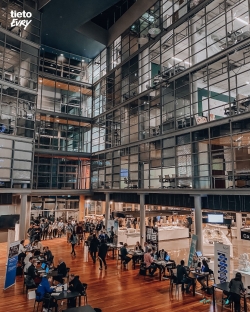
About Merck headquarters
At 2000 Galloping Hill Road in Kenilworth, New Jersey, a large corporate campus is changing hands and purpose. For years, the property was associated with Merck’s pharmaceutical research and headquarters operations. It is now branded NEST, the Northeast Science & Technology Center, and is being repositioned as a private campus for laboratories, biomanufacturing, offices and technology uses. This is not a conventional visitor attraction: the campus is designed for tenants and controlled access, and no public sightseeing hours or general tours are listed. Its story is nevertheless worth understanding because it shows how a suburban pharmaceutical headquarters is being adapted for a new mix of research and computing.
From corporate headquarters to a campus in transition
Merck announced in February 2023 that it had agreed to sell its 108-acre Kenilworth campus to Onyx Equities. The company said it would leave in phases as its headquarters in Rahway completed an expansion. The borough’s planning records describe the former property as about 106 acres, while other project materials use figures around 107 or 108 acres. These are slightly different published measurements and should not be treated as separate sites. The reliable point is that this was a very large, single-user campus on Galloping Hill Road, rather than a small standalone office building.
Kenilworth’s redevelopment plan describes a property developed for one corporate occupant, with research and office buildings, support facilities and substantial campus infrastructure. The borough adopted a redevelopment plan for the site in September 2024 after review by its Planning Board and a public hearing. That action created a framework for possible new uses; it did not mean the entire property instantly became a finished public destination. The plan’s stated direction is to repurpose an underused corporate campus while retaining opportunities for office, laboratory, industrial, commercial and retail activity.
What NEST is today
The campus now markets itself as NEST, short for Northeast Science & Technology Center. Its operator describes more than two million square feet of purpose-built office, laboratory and support space across a campus of more than 100 acres. The current site map identifies buildings by address-style names, including 1, 5, 11 and 15 NEST, along with dedicated vivarium and biomanufacturing facilities. That naming system is useful when reading current leasing material: the former Merck property is not one public building but a collection of specialized facilities with different users and functions.
NEST’s leasing page presents 15 NEST as a large research-and-development building of approximately 1.24 million rentable square feet, with space described for research, biomanufacturing and offices. The operator lists wet laboratories, chemistry and biology labs, vivarium space, conference and cafeteria facilities, a fitness center, loading and warehouse areas, a heliport and extensive parking. These are campus marketing details, not visitor amenities. Their importance is that existing infrastructure can make a former pharmaceutical site attractive to organizations that need utilities, technical space and room for specialized operations.
The site also reflects how redevelopment happens in stages. Kenilworth’s 2025 meeting records document conditional redevelopment designations and project-related municipal actions for subdivided portions of the property. The borough’s materials distinguish planning approvals from completed construction. That nuance matters: a plan, tenant announcement or approval describes an intended use, not necessarily a finished facility. In this case, the campus is being marketed for multiple tenants even as individual parcels pursue distinct projects.
The NEST 11 data-center project
One major new use is planned for NEST 11. CoreWeave describes its Kenilworth project as the redevelopment of a former pharmaceutical research building at 2000 Galloping Hill Road into an artificial-intelligence data center. The company says the project is under construction and identifies it as its first facility under construction in Kenilworth. The New Jersey Economic Development Authority’s 2025 board materials describe a proposed facility of about 392,600 square feet, involving renovation of an existing three-story research building and new construction. These details concern a specific building and parcel, not the whole NEST campus.
That change links the site’s scientific past with a different kind of technology infrastructure. Laboratory campuses and data centers both require substantial power, cooling and technical systems, although the work performed inside is very different. The company’s project page describes its own development; the borough’s records provide the public planning context. Because construction schedules and project scope can change, readers should treat company milestones as current project information rather than assume the data center is already operating. The redevelopment is active, but it is not a public exhibition of either pharmaceutical research or computing equipment.
Why the site is not open like a museum
NEST’s official website is directed at prospective research and commercial tenants: it invites organizations to inquire about space and advertises laboratory, manufacturing and office capacity. It does not publish public visiting hours, ticket prices or a general visitor route. Merck’s former offices and laboratories were work areas, and the campus is now being leased and redeveloped for business use. Travelers should not arrive expecting to enter buildings, see laboratories or walk freely around the grounds. Any access would need to be arranged with the property operator, a tenant or an event organizer.
For someone interested in corporate history, the useful encounter is therefore contextual rather than touristic. The address helps locate a major former pharmaceutical campus within Kenilworth, while the official records explain its transfer, zoning and planned evolution. Merck’s announcement also emphasized the company’s move to Rahway, which it described as its U.S. birthplace and expanding headquarters. That prevents a common mistake: the Kenilworth property is a former Merck campus, not Merck’s current headquarters.
Understanding the next chapter
The change from Merck campus to NEST is not a simple conversion from one company to another. It combines ongoing leasing of laboratory and office space, redevelopment of selected parcels, and a major data-center project in one former research building. The borough’s plan provides a wider framework, while the NEST operator and CoreWeave describe their own parts of the site. Keeping those sources distinct gives a more accurate picture than calling the entire property either a completed technology park or a single data center.
There are no confirmed public hours, promotions or sightseeing facilities to plan around, so the practical advice is straightforward: treat 2000 Galloping Hill Road as an active, private business campus. Check NEST’s official leasing information if you represent an organization seeking specialized space; consult Kenilworth’s redevelopment page for municipal planning records; and use CoreWeave’s project page for its current account of NEST 11. The site’s interest lies in a visible transition—from pharmaceutical headquarters to a multi-tenant science and technology campus—whose next stages will be shaped by tenants, construction and local planning rather than by tourist visits.