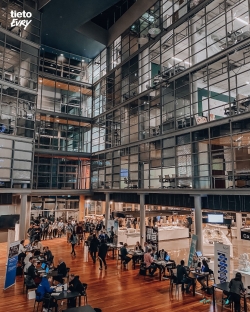
About Interbank headquarters
At the meeting of Lima’s Vía Expresa and Avenida Javier Prado, the Interbank Tower announces itself before a visitor reaches the district around it. Its tilted, sculptural profile is unlike a conventional glass office block, and its position beside fast-moving roads makes it one of the capital’s most recognizable corporate buildings. Designed by Austrian architect Hans Hollein, it is still the bank’s principal headquarters. The tower is worth seeking out as an example of modern Lima architecture, but it is a working office, not a museum with published sightseeing hours. Knowing that distinction makes the visit more rewarding—and avoids mistaking a nearby bank branch’s schedule for access to the building.
A headquarters shaped by its unusual site
Hollein’s project archive dates the planning period to 1996–2000 and the building’s completion to 2001. The site sits beside the interchange linking the Paseo de la República expressway, also known as the Vía Expresa, with Javier Prado Avenue. Rather than hide this awkward, highly visible setting, the design responds to it: the tall slab bends along the curve of the road loop, while a lower, simpler block relates to the surrounding street grid. The result reads as a pair of connected forms rather than a single anonymous tower.
The architect describes the principal high-rise as approximately 90 metres tall. His archive also records a broad program: offices in two distinct volumes, an entrance hall, a branch bank, an auditorium planned for 300 people and a helipad at the top, above five underground levels for parking and technical services. Those details help explain why the complex is more than a sculptural façade. It was conceived to combine public-facing banking, corporate work and large internal functions within a constrained urban site.
Interbank’s own 25th-anniversary account, published in January 2026, says Hollein travelled through Peru and drew inspiration from Inca architecture. The bank specifically connects the tower’s rounded massing with the chullpas of Sillustani and its stone base with the walls of Sacsayhuamán. These are references, not literal replicas: the building translates forms and materials associated with Peru’s architectural past into a late-twentieth-century corporate commission. Seeing the tower through that lens adds context without reducing the design to a single borrowed motif.
Construction also involved an unusual structural challenge. Project builder COSAPI describes the main tower as leaning toward the expressway, with a displacement of about three metres at the top, and notes the five basement levels. The inclination is part of the building’s public silhouette, but the engineering behind it is not something a street-side view can fully reveal. Hollein’s description emphasizes the relationship between the curved tower, the lower block and the surrounding urban pattern; together, those choices make the building feel tailored to this junction rather than dropped into it.
How to read the tower from the street
From outside, look first at the contrast between the rising, inclined volume and the lower building beside it. Then notice how the high-rise follows the sweep of the interchange while the shorter block keeps a more rectilinear presence along Carlos Villarán Street. The project’s visual effect changes with the viewing angle: the tower can appear to lean, curve or narrow against the Lima sky. That shifting outline is a useful reason to pause and look from a safe public sidewalk, rather than trying to appreciate it from the expressway itself.
The surrounding roads are major traffic routes, not places to stop for photographs. Use ordinary sidewalks and legal crossings, follow local traffic signals, and do not walk onto ramps or road shoulders. The tower’s address is Avenida Carlos Villarán 140, in Santa Catalina, district of La Victoria, according to Interbank’s public information. It stands at the edge of a busy urban corridor, so allow extra time to orient yourself and choose a safe approach. The address is a navigation point, not an invitation to enter restricted office areas.
Architecture enthusiasts may find the location especially interesting because the building connects several scales of Lima: the expressway infrastructure, the office district that grew around it, and the city’s continuing use of historic references in contemporary design. It is best approached as an exterior landmark and as a work by Hollein, whose own project record gives unusually direct evidence about the design’s planning and program. The site does not need a staged visitor experience to be legible; its relationship to the road junction is visible from public space.
Bank services are not building tours
Interbank’s location finder lists a customer-service branch called “Tienda Torre” at Avenida Carlos Villarán 140. The schedule currently shown is Monday through Friday, 9:00 a.m. to 6:00 p.m., and Saturday, 9:00 a.m. to 1:00 p.m. These are the published hours for the banking branch, not opening hours for the tower as a tourist attraction. A person visiting for a banking transaction should check the bank’s current listing before travelling, since service locations and schedules can change.
The official location page does not advertise architectural tours, a public observation deck or general admission to the corporate floors. Interbank’s legal information treats its headquarters as administrative or operational premises, distinct from outlets intended for public service. On the evidence available, visitors should plan to view the exterior and use the branch only for services offered there; do not assume that the lobby, auditorium, offices or helipad are open to sightseeing. If you need access for a specific appointment or event, arrange it directly with the institution in advance.
There is no single museum-style timetable for a visit. A practical plan is to check the branch listing if you need bank services, confirm the address on the day, and set aside time to observe the building from public streets. Avoid promising yourself an interior visit based on photographs or older descriptions that mention an entrance hall or auditorium: those are features of the architectural program, not proof that they are open to casual visitors. Respecting this boundary makes the guide more useful and the visit more considerate of people working inside.
A modern Lima landmark with a grounded story
The Interbank Tower is compelling because its story can be read at several levels: as Hollein’s response to a difficult junction, as a corporate headquarters completed in 2001, and as a contemporary interpretation of forms the bank associates with Sillustani and Sacsayhuamán. Its angled profile is the first thing many people notice, but the lower block, layered program and urban setting complete the composition. A short exterior stop can therefore become a small lesson in how architecture negotiates movement, identity and place in a growing city.
For travellers interested in Lima beyond its colonial centre, the tower offers a different chapter of the city’s built history. Come for the design, take in the changing outline from safe public viewpoints, and keep expectations clear: the listed branch serves banking customers, while public sightseeing access to the headquarters is not advertised. That balance—an ambitious building visible in everyday city life, with a private working interior—makes the Interbank Tower a distinctive stop on an architecture-minded visit to Lima.