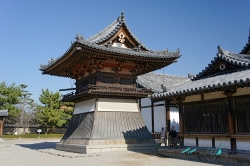
In Nara, the approach to Tōdai-ji leads through a city of ancient temples and into a compound whose scale announces a political as well as religious ambition. The temple’s official history traces its institutional origins to a small mountain retreat established in 728, before Emperor Shōmu’s government expanded the project. In 741, the court ordered provincial temples and convents across the country; Tōdai-ji became the principal temple of that state-supported Buddhist network.
The decision to create a monumental Buddha followed in 743. The image was conceived as Vairocana, or Rushana Buddha, whose name expresses the idea of light illuminating all things. Casting began after the court returned to Nara, and the bronze body was completed in 749 after repeated casting joins. The scale demanded an extraordinary mobilization of labor, resources and religious commitment. Tōdai-ji’s story therefore begins not simply with a statue, but with an attempt to connect the protection of the country with Buddhist teaching.