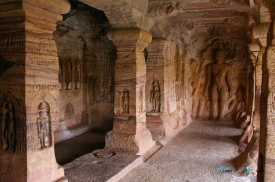
Pattadakal stands on the Malaprabha River in Karnataka, India, where Early Chalukya builders brought northern and southern temple forms into one remarkable ceremonial landscape. The World Heritage complex contains nine Hindu temples and a Jain sanctuary. It rewards close observation: tower profiles, column arrangements, narrative carvings and inscriptions reveal architectural experimentation rather than a single uniform style.
The monuments were created mainly in the seventh and eighth centuries under the Chalukya dynasty. India’s Ministry of Culture describes Pattadakal as the culmination of an artistic process also visible at nearby Aihole and Badami. Aihole is often associated with experimentation, Badami with the development of cave and structural forms, and Pattadakal with a mature synthesis. The place also served royal and ceremonial functions, including coronation traditions.