About Castletown House
Castletown House, Ireland: A Palladian Masterpiece Every Cultural Traveler Should Visit
For travelers who see the world as a living history book, Castletown House stands as one of Ireland’s most rewarding cultural destinations. Located in Celbridge, County Kildare, just a short journey from Dublin, this grand 18th-century residence is not only the largest Palladian house in Ireland, but also a powerful symbol of politics, art, and European influence during the Georgian era.
Castletown House is not a medieval castle or a romantic ruin. It is something rarer and, for many travelers, far more revealing: a carefully designed statement of order, power, and taste that connects Ireland directly to the architectural ideals of Renaissance Italy and Enlightenment Europe.
A House Built to Represent Power
Construction of Castletown House began in 1722 for William Conolly, Speaker of the Irish House of Commons and one of the wealthiest and most influential figures in Ireland at the time. Conolly’s vision was ambitious. He wanted a residence that would reflect not only his personal success but also Ireland’s place within the cultural and political elite of Europe.
The house became the centerpiece of an estate that once extended over 800 acres, carefully planned to impress visitors arriving from Dublin. From the beginning, Castletown was designed as a statement: architecture used as political language.
Palladian Architecture in Its Purest Irish Form
Castletown House is a textbook example of Palladian architecture, a style inspired by the principles of symmetry, proportion, and classical harmony developed by Italian architect Andrea Palladio in the 16th century.
The design involved some of the most important architectural minds of the era, including Alessandro Galilei and Edward Lovett Pearce, who helped introduce Palladian ideals to Ireland. The result is a façade defined by balance and restraint, built using limestone, marble, brick, and Portland stone—materials chosen for both durability and elegance.
Unlike Gothic castles designed for defense, Castletown House was conceived to be seen, admired, and interpreted. Its architecture communicates authority without aggression and luxury without excess.
Interiors Designed to Impress and Educate
Stepping inside Castletown House is a journey through the social rituals of the 18th century. Visitors ascend to the piano nobile, where a sequence of increasingly grand reception rooms unfolds, each one designed for a specific role in aristocratic life.
Highlights include:
The Long Gallery, nearly 80 feet long, decorated in the Pompeian style with rich blues, reds, and golds.
The Print Room, an exceptionally rare interior featuring decorative cut-outs, considered the only surviving example of its kind in Ireland.
The State Bedroom, reserved for viceroys and high officials rather than royalty.
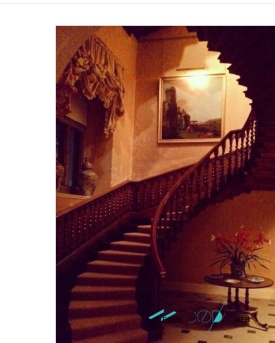
The monumental cantilevered staircase, carved from Portland stone, which remains one of the most striking architectural features of the house.
These interiors reveal how architecture, decoration, and social hierarchy were tightly interconnected during the Georgian period.
From Aristocratic Estate to Public Heritage
After remaining in the Conolly family for generations, Castletown House entered a period of uncertainty in the 20th century. Parts of the estate were sold, and the house itself faced the risk of neglect. Its survival is largely due to the efforts of the Irish Georgian Society, which recognized its national importance and worked to preserve it.
Today, Castletown House is owned and managed by Ireland’s Office of Public Works (OPW) and operates as a museum and cultural site open to the public. Recent restoration projects and the recovery of historic access routes have helped restore the original relationship between the house and its surrounding landscape.
The grounds, woodlands, and river walks now allow visitors to experience Castletown as it was intended: as a unified architectural and natural ensemble.
Why Castletown House Matters to the Modern Traveler
Castletown House is ideal for travelers who value depth over spectacle. It appeals especially to those interested in:
- European and Irish history
- Classical and Palladian architecture
- Cultural landscapes and heritage conservation
- Georgian art, politics, and society
Rather than overwhelming visitors with legends or myths, Castletown House offers something more substantial: a clear, readable narrative of how power, taste, and architecture shaped modern Ireland.
Practical Visitor Information
Location: Celbridge, County Kildare, Ireland
Distance from Dublin: Approximately 30 minutes
Status: Museum and public heritage site
Access: Guided tours, parklands, riverside walks
Official website: castletown.ie