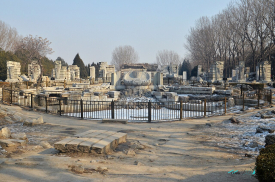
Where Human Evolution Was RewrittenOn a low limestone hill southwest of Beijing known as Longgushan — "Dragon Bone Hill" — a series of cave deposits yielded, over the course of the 20th century, one of the most important fossil records of early human life ever recovered. Zhoukoudian is the site where the remains of Homo erectus pekinensis, popularly known as Peking Man, were unearthed alongside more than 100,000 stone tools and evidence of controlled fire use stretching back hundreds of thousands of years. UNESCO inscribed the site as a World Heritage property in 1987, citing its exceptional value both as a scientific record of human evolution in Asia and as a rare, continuous cultural sequence spanning an extraordinary span of prehistory. A Fossil Trade Leads to a Landmark DiscoveryIronically, Zhoukoudian first attracted scientific attention through the local trade in "dragon bones" — fossils ground up for use in traditional Chinese medicine. Swedish geologist Johan Gunnar Andersson and Austrian paleontologist Otto Zdansky began excavating the site in the early 1920s, and in 1921 the team recovered an isolated fossil tooth that hinted at something significant. In 1927, Canadian anatomist Davidson Black examined the tooth and proposed that it represented an entirely new hominin species, which he named Sinanthropus pekinensis — "Chinese man of Peking." The claim, based on a single tooth, was met with considerable skepticism internationally. The 1929 Skullcap and Global RecognitionThat skepticism dissolved on December 2, 1929, when Chinese paleontologist Pei Wenzhong unearthed an almost complete fossil skullcap from the cave deposits — the first substantial physical evidence of an early human population in East Asia. The discovery made international headlines and triggered a wave of intensive excavation through the 1930s, eventually yielding remains attributed to more than 40 individuals, alongside the animal bones and stone tools that accompanied them. Later reclassified within the genus Homo erectus, Peking Man is now dated to roughly 500,000 to 700,000 years ago, making Zhoukoudian one of the key sites documenting the presence and behavior of archaic humans in Asia during the Middle Pleistocene. Fire, Tools, and a Longer Human StoryExcavations ultimately identified multiple occupation layers at Zhoukoudian spanning vastly different periods, effectively preserving several chapters of human prehistory in one location. Besides the Peking Man deposits, archaeologists documented the so-called "New Cave Man" layer, associated with humans living roughly 100,000 years ago, and the Upper Cave, home to anatomically modern humans — "Upper Cave Man" — dated to about 18,000 years ago, whose burial site yielded three complete skulls along with ornaments suggesting early symbolic behavior. Combined, the site's excavations have produced 118 identified species of animal fossils and over 100,000 stone artifacts, along with layers of ash long interpreted as evidence that Peking Man used and controlled fire — a claim later debated and refined by researchers, though the site's broader sequence remains foundational to the study of Asian human origins. Lost in the Chaos of WarZhoukoudian's scientific legacy is inseparable from one of paleontology's most notorious mysteries. As Japanese forces advanced through China and tensions with the United States escalated in 1941, foreign and Chinese researchers arranged to ship the original Peking Man fossils out of the country for safekeeping, reportedly intending to transport them aboard the SS President Harrison. The vessel came under attack and ran aground amid the outbreak of the Pacific War, and the crates said to contain the fossils vanished in the confusion — never definitively recovered to this day, despite decades of searches and competing theories about their fate. The originals remain lost; what survives in collections and museums are the detailed casts and measurements made by researchers before the fossils disappeared, which allowed later scientists to keep studying Peking Man's anatomy despite the loss of the physical specimens. Visiting Zhoukoudian TodayThe site today combines the excavated cave localities on Dragon Bone Hill with the Zhoukoudian Site Museum, which reopened in an expanded form in 2014 and displays more than 1,600 artifacts and fossil casts across three floors, reconstructing the sequence of discoveries from the 1920s onward. Located roughly 42 kilometers southwest of central Beijing, it remains an active reference point for paleoanthropological research into early human life in East Asia.
Key dates: 1921 first fossil find; 1929 Peking Man skullcap discovered by Pei Wenzhong; fossils lost in 1941 Age of fossils: Peking Man, c. 500,000–700,000 years old; Upper Cave Man, c. 18,000 years old Highlights: Remains of over 40 Homo erectus individuals; 100,000+ stone tools; evidence of early fire use; Zhoukoudian Site Museum (reopened 2014)