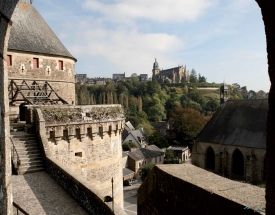
Vézelay rises above the Burgundy countryside as a compact hilltop town crowned by the Basilica of Sainte-Marie-Madeleine. The site is more than a church visit: its abbey, medieval streets and surrounding slope form a landscape shaped by pilgrimage, religious politics and later restoration. UNESCO inscribed the Basilica and Hill of Vézelay in 1979, recognising both the Romanesque monument and the setting that grew around it. Arriving on foot through the town gives the encounter its proper scale: a sequence of streets and views leading toward a church whose sculpture and architecture reward time rather than a hurried stop.
A Benedictine monastery was established at Vézelay in the ninth century. By the mid-eleventh century, a belief that it possessed relics of Mary Magdalene had made the abbey an important pilgrimage centre. The relics’ religious significance should be described as a medieval belief, not independently verifiable proof of their identity. The growing flow of pilgrims transformed the town and connected it to routes leading toward Santiago de Compostela. UNESCO notes that Vézelay’s population reached an estimated 8,000 to 10,000 in the twelfth century, a remarkable scale for that period.