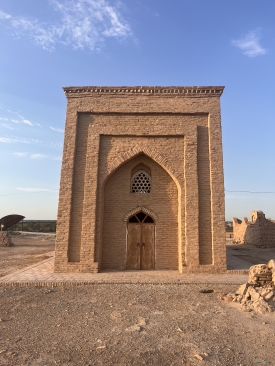
Itchan Kala is the walled inner town at the heart of Khiva, in Uzbekistan’s Khorezm region. The name distinguishes it from Dishan Kala, the outer town, and helps explain why the place feels less like a single palace or monument than a complete historic neighbourhood. UNESCO describes an urban enclosure about 26 hectares in area, laid out as a rectangle roughly 650 by 400 metres and surrounded by brick walls reaching up to ten metres. The walls have four gates aligned with the cardinal directions. Beyond them are lanes, courtyards, houses, mosques, madrasas, mausoleums, markets and caravanserais: an architectural setting that still belongs to the living city.
Itchan Kala was inscribed on the UNESCO World Heritage List in 1990. Its historical importance rests not only on the age of individual buildings but on the survival of an urban composition associated with Khorezm and Central Asian building traditions. UNESCO describes the inner town as the last resting place for caravans before they crossed the desert toward Persia. That position placed Khiva within networks of travel and exchange, while the walled centre provided a compact civic and religious landscape. The old town is therefore best understood as a whole: its monuments are striking, but the relationships between them and the streets are equally revealing.