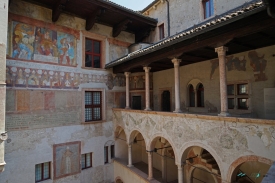
The finest Carolingian frescoes in the worldThe Benedictine Convent of St John the Baptist — in Romansh, Claustra Son Jon — stands at Müstair, in the Val Müstair of the Swiss canton of Grisons, close to the Italian border. A remarkably well-preserved monastery of the Carolingian era, it was inscribed on the UNESCO World Heritage List in 1983. A church from around 775At the heart of the complex is the convent church, built from about 775 as a simple hall church with three apses and a flat wooden ceiling. Its walls were covered with magnificent fresco cycles, and both the building and its paintings count among the most important surviving testimonies of the Carolingian Renaissance. Over the centuries the frescoes were whitewashed and forgotten; they were rediscovered in 1947 and uncovered by 1951. Layers of historyAround 1492, under the abbess Angelina Planta, a late-Gothic net vault was inserted about a metre below the original ceiling — which is why part of the fresco scheme now lies hidden above the vaulting — turning the hall into a three-aisled church. Beside the cemetery stands the two-storey Holy Cross Chapel, whose 8th-century timber floor is reckoned the oldest wooden beam ceiling in Europe. VisitingStill a living convent, Müstair welcomes visitors to its church and museum, where the Carolingian and later paintings can be seen in place. Location: Müstair, Val Müstair, canton of Grisons, SwitzerlandFounded: Carolingian era; church built from c. 775Highlight: The most important surviving cycle of Carolingian frescoesStatus: UNESCO World Heritage Site since 1983Visiting: Living convent with church and museum open to visitors