About Wudang Mountains
Wudang is not a single temple or a summit viewpoint but a mountain landscape in Hubei Province where Taoist buildings, steep terrain and later pilgrimage routes form one connected heritage story. UNESCO lists the Ancient Building Complex in the Wudang Mountains, inscribed in 1994, as an exceptional record of Chinese religious and secular architecture. For visitors, the distinction between the mountain scenery and the protected monuments matters: the experience involves moving among separate sites, and access to the popular Golden Summit is managed through timed reservations during busy periods. A thoughtful visit leaves room for both the architecture and the landscape that shaped it.
A sacred landscape with a long architectural record
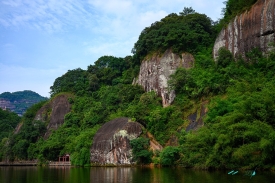
UNESCO traces Taoist buildings in the Wudang Mountains back as far as the seventh century, while the complex took organized form during the Ming dynasty, from the fourteenth through the seventeenth centuries. Its surviving structures reflect Yuan, Ming and Qing periods, not a single moment in history. The monuments occupy valleys, slopes and mountain peaks, showing how religious architecture was planned in relation to the terrain rather than imposed on a flat urban grid. The heritage value comes from that relationship as much as from the individual halls and gates.
At its Ming-era height, UNESCO records an ambitious complex of nine palaces, nine monasteries, 36 nunneries and 72 rock temples. Today the World Heritage description counts 53 ancient buildings and nine architectural sites. Among the named monuments are the Golden Shrine and Ancient Bronze Shrine, bronze structures dated to 1307; the stone-walled Forbidden City of 1419; Purple Heaven Palace, with elements dating to the twelfth, fifteenth and nineteenth centuries; and Nanyan Palace. The figures describe different historical and surviving inventories: the grand Ming-era complex was much larger than the buildings preserved today.
How to read the principal sites
The Golden Summit is the best-known destination, centered on Taihe Palace and the Golden Shrine at the mountain’s high point. Its fame can draw attention away from the rest of the heritage area, so consider adding other sites rather than treating the visit as a single climb. Purple Heaven Palace, Nanyan Palace and Taizi Po are among the major places identified in local visitor information. Their settings help explain the complex’s range: palace courtyards, temples and gates occupy different relationships to ridgelines, cliffs and routes through the mountains.
Nanyan is especially associated with dramatic rock-side architecture, while Purple Heaven Palace sits beneath Zhanqi Peak and forms part of the mountain’s historic Taoist landscape. Taizi Po is another stop on the commonly recommended route. The official 2026 guide also describes Qiongtai as a starting area for the cableway route toward the summit. These are not interchangeable names for one attraction; each marks a different place in a wide scenic area. Check the current map and entrance conditions before deciding how many to include in a day.
Wudang’s cultural identity also includes Taoist practice and martial arts. The official local portal presents buildings, religious culture and Wudang kung fu in separate sections, a useful reminder not to collapse architecture, religion and modern martial-arts teaching into one legend. UNESCO’s account is more specific about the physical evidence: palaces, temples and other structures illustrate nearly a millennium of artistic and architectural achievement. Visitors can appreciate the tradition without assuming that every popular story about a particular figure or fighting style is established historical fact.
Routes, transport and reservations
The area is reached through Shiyan and Wudangshan West. A 2026 guide published by the official local portal gives the high-speed rail station as about 12 kilometres from the scenic area, with bus 301 or a taxi taking roughly 25–30 minutes. Shiyan railway station is about 36 kilometres away and is connected by intercity bus 202; the airport is about 25 kilometres from the area and has a shuttle connection. Within the scenic zone, the guide describes sightseeing buses and a cableway, with a walking approach from the Nanyan direction or a cableway route from Qiongtai. Confirm the exact service and last departures for your date.
In 2026 the scenic area uses real-name online reservations, and the Golden Summit has separate timed-entry controls. During statutory holidays lasting three days or more, Taihe Palace and the Golden Summit require timed reservations and have a daily cap of 12,000 visitors: up to 7,000 before noon and 5,000 from noon until closing. Other scenic sites are not covered by that same summit reservation limit. Booking is handled through the “Wudangshan Smart Tourism” WeChat mini-program or authorized ticket channels; bring the identity document used for the booking. Do not rely on older web pages for ticket prices, because those can change and may separate the entrance, shuttle, cableway and site-specific charges.
Current October 2026 visitor information
For China’s National Day holiday, the visitor service center announced temporary scenic-area hours of 6:30 a.m. to 5:30 p.m. from October 1 through 7, 2026. Its notice says the regular 7:30 a.m. opening resumes on October 8, with closing at 5:30 p.m. The Golden Summit is separately capacity-controlled. On October 4, the visitor service center reported that Golden Summit tickets for October 4 and 5 were sold out and advised travelers without those reservations to change plans. It suggested visiting Taizi Po, Purple Heaven Palace or Nanyan with ticket options that do not include the summit. This is a dated status update, not a permanent rule about future availability.
Before departure, check the official mini-program and current notices for reservations, weather-related closures, cableway operation and ticket combinations. The official portal lists 0719-5668567 for general visitor information, tickets, opening hours and capacity policies; it also lists 0719-5689877 for the cableway and 0719-5669777 for sightseeing buses and parking transport. Those local numbers are useful if an online notice leaves a practical question unresolved. For the current holiday, plan around the published 6:30 a.m. opening and do not travel to the summit without a confirmed time slot.
A visit shaped by the terrain
Wudang rewards a slower itinerary. The UNESCO-listed buildings are part of a large mountain setting, so a visit that includes multiple temples involves transit, walking and time for changing elevations. Choose a manageable combination of sites, leave margin for queues and transfers, and follow posted safety instructions. After rain, the scenic-area authority has specifically warned that some surfaces can remain slippery; conditions on mountain paths can change, so footwear suited to uneven routes is sensible.
The strongest impression comes from seeing how architecture follows the mountain rather than competing with it. A bronze shrine, a palace courtyard, a cliffside temple and a long view across ridges tell different parts of the same story. With the current booking system understood in advance, visitors can look beyond the summit’s popularity and encounter Wudang as a landscape of religious practice, imperial building campaigns and carefully adapted design. That combination—not a single sweeping legend—is what makes the mountains and their ancient buildings worth discovering.