About The Getty Villa
The Getty Villa: a Roman country house reborn above the Pacific
Tucked into a canyon where the Santa Monica Mountains meet the sea north of Los Angeles, the Getty Villa is one of the most unusual museums in the United States: a working recreation of an ancient Roman country house, built to display one of the world’s finest collections of Greek, Roman and Etruscan art. Bougainvillea spills over colonnades, fountains play in formal gardens, and inside, marble gods and bronze athletes stand as they might have two thousand years ago.
The museum is the older half of the J. Paul Getty Museum, whose second campus, the hilltop Getty Center, opened later in Brentwood. But the Villa is where the Getty story began—and where it returns, again and again, to antiquity.
An oil magnate’s Roman dream
The Villa was the creation of J. Paul Getty, the oil billionaire and passionate collector of classical antiquities. Rather than build a conventional gallery, Getty chose to model his museum on the Villa dei Papiri, a luxurious Roman house at Herculaneum buried by the eruption of Vesuvius in AD 79 and known only from 18th-century tunneling. Because the original remains largely unexcavated, architects filled the gaps using other ancient houses at Pompeii and Herculaneum.
The museum opened in 1974. Getty, by then living in England, never visited the finished building; he died in 1976, leaving the institution an enormous endowment that would make it one of the wealthiest arts organizations in the world.
Forty-four thousand objects
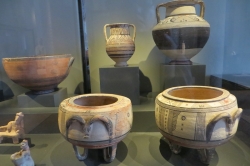
The Getty’s antiquities collection numbers roughly 44,000 objects spanning from about 6,500 BC to AD 400, of which around 1,400 are on view at any time. Highlights include Greek vases, Roman portrait busts and rare bronzes, displayed in galleries arranged by theme around a central peristyle. After closing in 1997 for a long renovation that reconceived it as a center for the study of the ancient world, the Villa reopened on January 28, 2006.
Gardens, theater and the setting
Much of the Villa’s magic lies outdoors. The Outer Peristyle, a formal garden about 308 by 105 feet, is centered on a long reflecting pool and ringed by bronze copies of statues found at the original Villa dei Papiri. A 450-seat outdoor Roman-style theater hosts classical drama each year, and the herb garden recalls the plants a Roman household would have grown.
Admission to the Getty Villa is free, but a timed-entry reservation is required and parking is charged per vehicle. The museum sits on a 64-acre site in the Pacific Palisades area between Santa Monica and Malibu, and typically closes on Tuesdays—always worth confirming before a visit, as hours and reservation rules can change.
- Location: Pacific Palisades / Malibu, Los Angeles, California, USA
- Opened: 1974 (reopened 2006); founded by J. Paul Getty
- Modeled on: the Villa dei Papiri, Herculaneum (buried AD 79)
- Collection: ~44,000 Greek, Roman and Etruscan antiquities
- Highlights: Outer Peristyle garden, Roman theater, ancient bronzes
- Visiting: Free admission with timed reservation; parking fee; closed Tuesdays