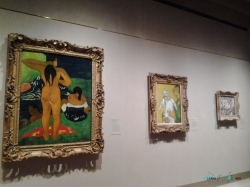
About Musée du Luxembourg
Tucked beside the Luxembourg Garden in Paris’s 6th arrondissement, the Musée du Luxembourg is small enough to fit into a wider Left Bank walk yet carries an unusually long institutional history. It is not the Luxembourg Palace and it is not a permanent encyclopedic collection: today, the museum presents temporary exhibitions, closing between shows. That distinction matters when planning a visit. In autumn 2026, its rooms are devoted to Andy Warhol’s drawings, offering a different entry point into an artist often associated first with screen prints and celebrity portraits.
A museum with several lives
The museum’s story begins in 1750, when a gallery in the east wing of the Luxembourg Palace opened paintings from the royal collection to the public. The Senate’s historical account describes it as the first French museum of painting open to the public and one of the earliest in Europe. Its early displays included major works from the royal holdings; the institution was part of a broader shift that made art once reserved for court life available to visitors.
In 1818, the Luxembourg became a museum for living artists, a pioneering home for contemporary art in France. Painters such as David, Ingres and Delacroix appeared there. The system connected the museum to the next stages of an artist’s reputation: works judged most significant could move to the Louvre after the artist’s death, while others went to regional museums or public institutions. The museum’s identity therefore changed with the question of what counted as “modern” art.
The building visitors see today was constructed by the Senate between 1884 and 1886 on rue de Vaugirard; this is the current museum building, not the palace’s original east wing. The museum closed in 1937 when modern-art collections moved to the Palais de Tokyo, then reopened to the public in 1979 for exhibitions. The Senate resumed full responsibility in 2000 and, from 2010, entrusted exhibition management to the Réunion des musées nationaux–Grand Palais. The long timeline is useful context: the name has survived several institutions and changing roles.
What is on view in 2026–27
The museum no longer has a permanent collection. It opens during exhibition periods and closes between temporary shows, so a visit should be tied to a specific exhibition rather than an assumption that galleries are always open. From 16 September 2026 through 10 January 2027, the program is “Andy Warhol. The Line and the Image.” Check the museum’s current calendar before travel, especially if your dates fall near the end of that run or between exhibitions.
The museum says the exhibition brings together 150 works across five thematic sections. Its focus is drawing—not as a minor preliminary to Warhol’s better-known paintings and screen prints, but as a practice that accompanied his career. The story begins with an early self-portrait dated 1942 and reaches drawings connected with The Last Supper in 1986. The museum’s account describes drawing as a place where Warhol tested images, lines and visual ideas before or alongside their reproduction.
Visitors can also encounter archival material from The Factory, including scrapbooks, video, advertising prints and preparatory drawings for major works. The exhibition’s argument is that Warhol’s image-making did not begin and end with the mechanical processes for which he became famous. For a traveller who has seen the familiar celebrity portraits, the show offers a chance to follow the quieter, more exploratory work behind them. The precise selection belongs to this temporary exhibition and should not be mistaken for a permanent display.
Opening hours, tickets and getting there
During exhibitions, the museum is open daily from 10:30 a.m. to 7 p.m., with a late opening on Mondays until 10 p.m. The published schedule lists closure on 25 December and special hours of 10:30 a.m.–6 p.m. on 24 and 31 December. The last entry is 45 minutes before closing, and visitors begin leaving the exhibition rooms 15 minutes beforehand. Ticket sales and access can stop earlier than the final evacuation, so avoid arriving at the end of the day.
For the Warhol exhibition, the museum lists a standard ticket at €14 and a reduced ticket at €10. The reduced rate includes visitors aged 16–25, jobseekers and large families. Visitors under 16 and people receiving specified minimum social benefits are admitted free with the required conditions. A “special young” offer allows two people aged 16–25 to enter for €10 together on weekdays after 4 p.m.; a separate “Places aux Jeunes” allocation offers free admission to 16–25-year-olds by reservation, subject to availability. Check the live ticket page for eligibility and any changes before paying.
The address is 19 rue de Vaugirard, 75006 Paris, beside the Luxembourg Garden. The nearest RER stop is Luxembourg on line B, using the garden exit. Metro stations Saint-Sulpice (line 4), Mabillon (line 10) and Rennes (line 12) are also within walking distance; several city bus routes stop nearby. Online booking is recommended, though the museum says same-day tickets may be purchased at the desk when available. Exhibition visits take about an hour, according to the museum’s FAQ.
Access and a more comfortable visit
The museum is accessible to visitors with reduced mobility, with a lift reached from the forecourt. A wheelchair can be borrowed by named reservation 48 hours ahead; contact the museum directly to arrange it. The museum also offers specific visits for some access needs. Because practical arrangements can change, confirm details with the institution before the visit rather than relying on an old directory entry.
There is no general luggage-storage service. The museum says a small bag with a combined dimension of up to 115 centimetres may be accepted at the security team’s discretion; larger bags and hiking backpacks are not a safe plan. Private photography without flash or a tripod is generally allowed unless a particular work is marked otherwise. The tea room on the forecourt can be visited separately after passing the security check, but leaving the exhibition means you cannot return on the same ticket.
A good visit begins with the date, not just the address: confirm that an exhibition is open, check its current ticket terms, and allow time for security and the walk from the nearest station. Then give the galleries enough room to make their case. The Musée du Luxembourg’s appeal lies both in what is on its walls now and in its history as a place where public art, living artists and changing definitions of modernity have repeatedly met. In 2026, Warhol’s drawings make that history feel immediate, tracing how an image takes shape before it becomes an icon.