Kalyan Minaret: Bukhara’s 1127 tower and old city
A tower at the heart of Bukhara
The Kalyan Minaret stands over Bukhara's old centre with a presence that is architectural before it is legendary. Built in 1127 under the Karakhanid ruler Arslan Khan, according to Uzbekistan's official tourism portal, it belongs to the Poi-Kalyan ensemble. The tower's patterned brickwork and vertical silhouette make it a defining landmark, but its importance is not simply its height. It marks a place where worship, civic authority and the city's long urban history meet. The surrounding square is therefore the right scale at which to begin: a minaret alone cannot explain the ensemble that grew around it.
Bukhara lies on the historic Silk Roads. UNESCO describes its old centre as one of Central Asia's best preserved medieval urban fabrics and inscribed it as a World Heritage site in 1993. The minaret is one of the relatively early monuments that survives within a city largely shaped by later centuries. This is what makes it especially useful for reading Bukhara: one structure from the Karakhanid period stands in conversation with mosque and madrasa buildings that took their present form much later.
Stories about the tower are plentiful. The national tourism portal recounts a tale that Genghis Khan's helmet fell when he looked up, causing him to bow and spare the structure. It is a legend, not a reliable account of the Mongol conquest. The better documented foundation is the 1127 construction attributed to Arslan Khan. That distinction does not make the local story irrelevant; it shows how later generations have explained the survival of a monument they considered extraordinary.
Brickwork and the wider ensemble
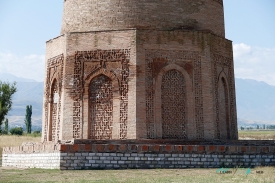
The minaret's brick decoration rewards attention from the ground. Bands and changes in pattern lend rhythm to the tall shaft without relying on a painted surface. UNESCO calls it a masterpiece of decorative brickwork. Its original religious function was to call the faithful to prayer, a purpose identified by Uzbekistan Travel. Standing in the square, it is possible to see how that vertical marker announces a sacred and civic centre within the dense old town.
The neighbouring Kalon Mosque and Miri Arab Madrasa belong to later building phases. Uzbekistan Travel describes the Poi-Kalyan group as an ensemble formed between the twelfth and sixteenth centuries. Its current composition is strongly associated with sixteenth-century construction. The juxtaposition is the point: the minaret did not emerge as an accessory to buildings of precisely the same date. It survived while the area around it was rebuilt, showing continuity of place even as its architecture changed.
The UNESCO description of Bukhara places this group within a larger townscape that also includes the Ismail Samani mausoleum, Magoki Attori Mosque, Lyabi-Hauz and other monuments. The World Heritage value lies in the relationships among buildings and streets, not in a checklist of isolated façades. After studying the minaret, look outward along the urban routes and consider how the square connects religious institutions with the old trading city. Avoid assuming every nearby building belongs to the same century; Bukhara's continuity rests precisely on layers.
How the city endured
UNESCO identifies Bukhara as a centre of trade and Islamic learning over many centuries. It notes that the city experienced Mongol and later upheavals, yet retained a substantial historic fabric. The minaret is among the earlier survivals. Its persistence should not be turned into a simple miracle tale, however. The formal World Heritage assessment also records threats from salt, groundwater, termites and unsuitable modern construction. Conservation is a continuing task in a living city, not a one-time declaration that every wall is safe.
That larger context changes the way one walks through Bukhara. The minaret is a landmark for orientation, but it is also a witness to the city's repeated rebuilding. Religious schools and mosques around it speak to centuries of teaching and worship. Market routes and squares speak to exchange. People still use the old centre, so it should be approached as an inhabited urban space rather than an abandoned museum. A respectful visitor observes current uses and access rules as carefully as historic masonry.
The tourism portal attributes the tower's design to a local architect named Bako and says his name appears near the upper part. It also reproduces stories about earlier failed attempts to build a tower. Those stories should be read as traditions unless independently verified. The physical evidence that a visitor can confidently appreciate is the composition of the shaft, its decorative brick and its place in the Poi-Kalyan ensemble. They are substantial enough without adding an invented climb or theatrical account of the past.
Planning a careful visit
As of October 2026, the official sources checked here do not provide a dependable public schedule or ticket price for climbing the minaret, nor do they establish that ascent is generally available. Plan to see it from the accessible public space of the historic centre and confirm any interior access locally with the authorized site operator. The adjacent mosque and madrasa have their own religious and institutional functions; entry conditions may differ, and a visible doorway is not an invitation to walk in.
Give the ensemble time rather than treating it as a quick photo stop. Start by seeing the full tower and its relationship to the square; then move closer to study the brick patterns and take a wider walk through the UNESCO-listed centre. Dress and behave respectfully around places of worship, follow signs and ask before photographing people or entering active religious spaces. If conservation work affects a route, follow the current barriers. These are practical ways to protect both the site and the lives that continue around it.
The Kalyan Minaret is powerful because it holds several scales together. Its twelfth-century Karakhanid context, the 1127 date given by national tourism, the later mosque and madrasa, and Bukhara's surviving street pattern all meet in one square. Legends may draw the eye upward, but the strongest story is underfoot: a city that repeatedly changed while keeping an extraordinary architectural memory. See the tower as part of that living fabric, and it becomes much more than a solitary monument against the sky.