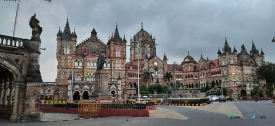
About Finland Station
Finland Station is best approached as a working railway terminal with an unusually layered past, not as a museum frozen around one famous arrival. Commuters still cross its halls and platforms, while the square outside carries the name of Vladimir Lenin. The station’s story links St Petersburg to Finland, to the upheavals of 1917 and to the city’s survival during the siege of Leningrad. A visitor can read these histories in the rail infrastructure itself, in a memorial locomotive and in the station’s own account of its role.
The line began operating before the station building familiar today. The station operator records a trial train leaving St Petersburg on 22 June 1869 and reaching Pargolovo; the first stone station was completed soon afterward. Russian-language historical references date the formal opening to 1870, when the Finland Railway connected the imperial capital with the Grand Duchy of Finland. Its original purpose was practical: moving passengers and goods along a northern route. The name refers to that historic railway connection, not to a present-day international service timetable.
A railway terminal shaped by changing eras
The current station complex was built between 1955 and 1960, according to the operator, by architects P. A. Ashastin, N. V. Baranov and Ya. N. Lukin, with engineer I. A. Rybin. Later alterations changed the passenger routes and the surrounding square. The terminal is therefore not simply the nineteenth-century building preserved intact; it is a modern transport hub that retains selected memorial traces of the earlier station.
Its most internationally recognized chapter began in April 1917. Vladimir Lenin returned to Petrograd from exile by way of Finland and arrived at this station during the political crisis following the February Revolution. The date is given in two calendars: 3 April in the Julian calendar then used in Russia, or 16 April in the Gregorian calendar. A monument outside depicts Lenin addressing a crowd from an armored vehicle. It is a Soviet-era memorial interpretation of a consequential political event, and visitors can distinguish the monument’s public symbolism from the documented railway arrival itself.
Another memorial on the platform is steam locomotive H2-293. The station’s official history says Lenin used it to cross the Finnish border secretly in 1917; it was installed beside the platform in 1961. The locomotive is displayed in a glass pavilion, so it can be seen as part of the station environment rather than through a conventional museum visit. Its presence turns an ordinary railway platform into a place where transport history and political memory meet.
The station during the siege
Finland Station’s history also reaches the siege of Leningrad during the Second World War. The railway operator states that it was the only Leningrad station to continue working through the blockade and that it served as a starting point for the Road of Life supply route. On 7 February 1943, after the blockade had been broken, the first train from the mainland arrived there. These details explain why the site carries a civic memory beyond Lenin’s return: rail access was connected to food, evacuation and the city’s efforts to remain linked to the rest of the country.
The station’s memorial plaques refer to Lenin’s arrivals in 1905–06 and 1917, while a plaque on the building records the opening of the Riihimäki–St Petersburg railway. These markers offer a compressed chronology in Russian and Finnish. The city square has also been redesigned over time, so it is worth looking at the station, the monument and the surrounding streets as a single urban setting rather than treating one object as the whole site.
For a visitor, the most useful distinction is between the public memorial landscape and the passenger-only parts of an active railway. The station is not a ticketed museum, but access to platforms and boarding areas is governed by railway rules and security procedures. Current train destinations, fares and seat availability should be checked with Russian Railways; historic references to Finland do not establish that an international train is currently running.
Practical information and current travel context
As checked on 3 October 2026, the official station page lists the main building and waiting hall as open around the clock. The west and east suburban pavilions are listed from 6:10 a.m. to 12:30 a.m.; suburban ticket counters operate 5 a.m. to midnight. The address is 6 Lenin Square. Services include ticket offices, waiting areas, luggage lockers, cafés and assistance for passengers with reduced mobility. Timetables and service arrangements can change, so check the live station board or official railway website rather than relying on a printed schedule.
Allow time to see the memorials without obstructing passenger movement, and follow signs for the correct entrance: long-distance train boarding uses the Express Hall on Botkinskaya Street, according to the station operator. Visitors should not enter restricted platforms or photograph security-sensitive areas where prohibited. There is also an essential travel caveat: on 3 October 2026, the UK Foreign, Commonwealth and Development Office advised against all travel to Russia. That guidance is specific to UK travellers, but anyone considering a visit should review their own government’s current advice, entry requirements and transport options. Finland Station remains both a functioning terminal and a historical landmark; understanding the difference makes a visit more informative and more respectful of the people using it today.