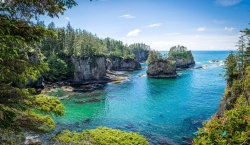
About Cape Alava
Cape Alava is a remote stretch of Olympic National Park’s Pacific coast, reached on foot from the Lake Ozette area of Washington’s Olympic Peninsula. The route moves from a forest and coastal prairie to a rocky beach facing the open Pacific, where sea stacks, tidepools and changing light define the view. This is not a roadside viewpoint: even the shorter out-and-back hike covers several miles, and the coast is governed by tides and weather. A worthwhile visit begins with a map, a tide plan and a realistic sense of the distance.
Forest boardwalk to the Pacific
The Cape Alava Trail starts near the Ozette Ranger Station at Lake Ozette. The National Park Service describes the route as about 3.1 miles one way, crossing prairie and coastal forest on boardwalks, stairs and trail before reaching the beach. NPS sources round the distance slightly differently, so use the current park map and trail report for planning rather than relying on a single mileage figure. The return covers the same route; visitors looking for a longer outing can connect with the Sand Point Trail along the coast to form the roughly nine-mile Ozette Loop.
The trail’s surface is part of the experience. Boardwalks protect wet ground and plant life, but can become slick when wet or frosty. The forest gives way to a broad, exposed shoreline with rocks, driftwood, tidepools and offshore sea stacks. Conditions can change quickly between the shaded trail and the Pacific beach. Wear footwear with reliable grip, allow extra time, and be prepared to turn back if wind, surf, rain or the trail itself makes the route unsafe.
Ozette is also a place of deep Makah history. The National Park Service describes archaeological evidence of a Makah coastal village that was preserved beneath a landslide and later excavated, with more than 50,000 artifacts recovered. Many are held at the Makah Cultural and Research Center in Neah Bay. The story is not simply an archaeological curiosity: it reflects generations of Makah life on this coast. Visitors should stay on marked routes and leave cultural and natural materials where they are; removing or disturbing objects damages a living heritage as well as a protected landscape.
Tides, weather and coastal safety
Reaching the beach is only part of the planning. Some sections of Olympic’s coast become impassable at high tide, and storm conditions can raise water levels and create dangerous surf. The NPS recommends carrying a current tide table and a topographic map that marks headlands, then checking whether the planned time window allows safe passage. Do not rely on a phone signal or assume that a route passable at one tide will remain open later. If a headland or crossing looks unsafe, wait for the correct tide or turn around.
The Ozette Loop links Cape Alava and Sand Point by a beach walk of roughly 2.9 miles, creating a route of about nine miles overall. The coastal connection is not a simple extension of the boardwalk: its passability depends on the tide, surf and the specific shoreline. For a first visit, an out-and-back walk to Cape Alava is easier to plan than committing to the complete loop. Check the park’s current trail-condition report shortly before leaving; NPS notes that reports rely on staff and visitor observations and can lag behind changing field conditions.
Weather deserves equal attention. Olympic’s coast can be cool, wet and windy even when other parts of the peninsula are mild. Rain and frost make boardwalks slippery, while storms can bring strong winds, high surf and erosion. The NPS advises visitors to check marine forecasts and road conditions. Cell coverage is limited in remote areas of the park, so tell someone your plan, carry food and water, and do not treat the ranger station as a guaranteed source of last-minute equipment or permits.
Access, fees and overnight options
To reach Ozette, follow Hoko-Ozette Road from Highway 112 to the trailhead area by Lake Ozette. The approach is long and remote, so fuel, food and lodging should be arranged before leaving larger communities. NPS identifies a parking lot, restrooms, picnic facilities and a seasonally staffed ranger station near the trailheads. At the time of review, the park entrance pass was $30 per private vehicle, valid for seven consecutive days, or $15 per person entering on foot or bicycle; other passes are available. Fees and payment options can change, so confirm them on the NPS page before travel.
Day hiking and overnight backpacking have different requirements. NPS lists the Ozette Campground beside the lake as a separate, developed option with 15 sites, first-come registration and a current fee of $20 per night; some sites can flood in winter, and severe weather may prompt a closure. Camping on the wilderness coast requires a separate wilderness permit, with permits limited year-round in the Ozette area. The ranger station does not issue those permits. Reserve through the park’s current trip-planning system, and carry an approved bear canister for food, garbage and scented items on the coastal wilderness route.
Facilities are intentionally limited. Bring what you need for the day, pack out all rubbish, and keep pets off the Ozette trails and beaches, where NPS prohibits them. Fires are restricted in parts of the coast, and rules for overnight use are stricter than for a day walk. Do not confuse a campground reservation or national-park entrance pass with permission to camp anywhere along the shore. Check the relevant NPS pages for the exact permit, campsite and current closure requirements that apply to your plan.
Why Cape Alava rewards careful planning
Cape Alava’s appeal comes from the transition: a quiet walk through coastal forest opens onto a Pacific shore shaped by surf, tides and weather. The view is beautiful, but it is not a managed promenade with predictable conditions. The Makah history of Ozette adds another dimension, reminding visitors that this coastline is both a wilderness environment and a homeland with a long human story. Moving slowly and following local rules makes the visit more meaningful than trying to cover the greatest distance.
Before setting out, check the current Ozette alert page, tide predictions, marine forecast, road conditions, park entrance requirements and—if staying overnight—the wilderness permit system. A day hike to the beach and a multi-day coastal route are different undertakings. With the right tide window, suitable footwear and enough time to return, Cape Alava offers a memorable way to experience Olympic National Park’s rugged northwest coast while respecting the forces and communities that have shaped it.