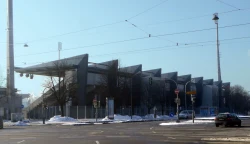
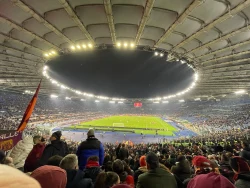
Arena Lviv: from Euro 2012’s new stadium to a place of refuge
A new arena for a European summer
Arena Lviv began with a promise of international gathering. Opened ceremonially on 29 October 2011, it was the last of Ukraine's four stadiums prepared for Euro 2012 to be unveiled. Its later history would give that idea of gathering a different meaning. Alongside football and architectural ambition came matches for a displaced club and, after the full-scale invasion, accommodation for people forced from their homes.
The opening ceremony and the first match were separate occasions. The celebration presented a new building through performance and music; Ukraine then played Austria on 15 November 2011. Artem Milevskiy scored first, and Marko Dević's late winner secured a 2–1 home victory. The dates mark different beginnings: the introduction of the arena to the public and its first recorded international football encounter.
UEFA's contemporary account described upper seats predominantly blue and lower seats mainly yellow, reflecting Ukraine's flag. Such details made the interior part of the occasion rather than a neutral container. The stadium was new, but it immediately acquired associations through colour, a national-team debut and the anticipation of supporters arriving for the following summer's tournament.
Two tiers and a promenade
The operator's architectural description emphasises the relationship between the two seating tiers. A circulation promenade runs around the arena between them, distributing spectators and linking the stands with services. This is a defining spatial feature: the building was organised not only for looking at the pitch but also for the movement of large numbers of people around it.
A partly transparent roof covers the seating, while a five-storey administrative building accommodates functions such as changing rooms, media facilities and event spaces. The different uses explain the ambition to operate beyond individual football fixtures. A stadium requires rooms and circulation that a television image of the playing field rarely shows, even though these help make the event possible.
The original design also incorporated rainwater collection in two basins for later use in irrigation. That is a specific environmental feature, rather than a reason to claim the whole building has no environmental impact. Exact seat totals vary within older published descriptions, so a changing technical capacity should not become the centre of the story. Its layout and intended functions offer a more useful architectural introduction.
Football beyond the opening celebration
Arena Lviv hosted three Euro 2012 GroupB matches. Germany defeated Portugal 1–0 on 9 June, Portugal beat Denmark 3–2 on 13 June, and Germany overcame Denmark 2–1 on 17 June. These were group games, not the final, which took place in Kyiv. Keeping the fixtures in their proper cities helps distinguish Lviv's part in a tournament shared across Poland and Ukraine.
The arena later became part of Shakhtar's history away from Donetsk. In a retrospective published on 11 December 2020, the club counted seven Champions League main-stage home matches at Arena Lviv after its displacement in 2014. That record adds another kind of connection to the building: a home fixture could take place far from the club's home city.
It also cautions against treating an old list of tenants as a permanent description. The venue, the national team and the clubs using it have distinct histories. A past Shakhtar fixture or an archived reference to another team does not establish where its next match will be played. The arena's sporting identity has grown through changing uses, not through one unbroken arrangement with a single club.
Refuge and the limits of a visitor guide
On 21 August 2022, Ukraine's Parliamentary Commissioner for Human Rights reported a visit with an ENNHRI delegation to temporary accommodation for internally displaced people at the stadium. The documented inspection considered sleeping arrangements and supplies including food, clothing and hygiene items. A building created for an international football audience was serving people whose movement was a necessity rather than a holiday.
That record concerns a particular humanitarian use in 2022. It should not be turned into a claim about current accommodation availability, or an invitation to visit a shelter. The operator's listings of tours, conferences and other services likewise require present confirmation. Different kinds of public use can appear in one stadium's history without being simultaneously available to every visitor.
British FCDO advice updated on 2 October 2026 and checked on 29 October advises against all but essential travel to Lviv region; a leisure stadium trip is not recommended. This differs from the advice against all travel to some other Ukrainian regions, but does not make Lviv free of missile and drone risk. For now, the arena's records offer a way to understand its changing role: tournament architecture, football away from home, and a documented place of refuge.